
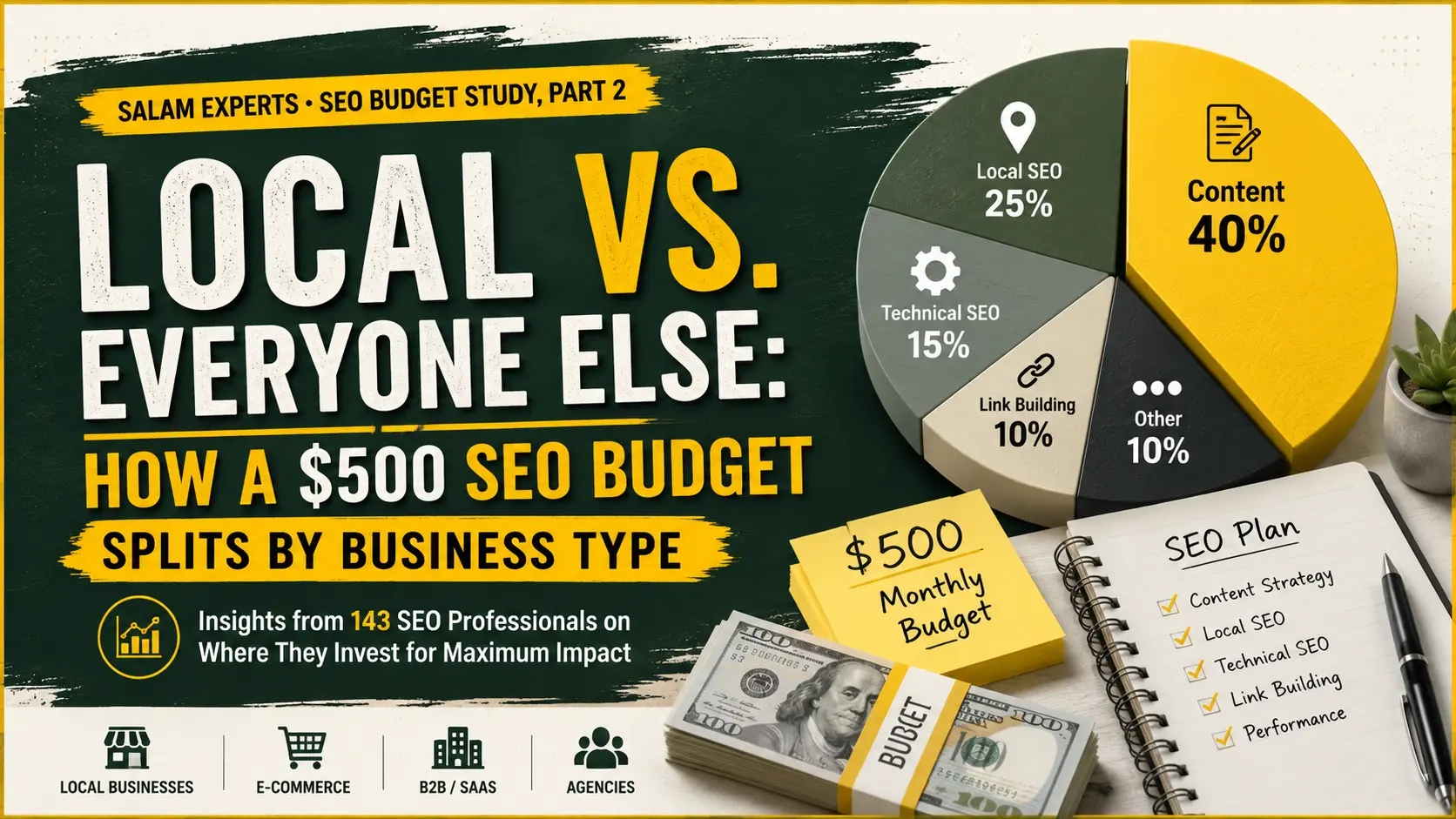
A follow-up cut of our 143-response study on how SEO experts would spend a $500/month budget. Content-first wins across every business type — but what people pick second is not the same at all, and local businesses look nothing like the rest of the field.
When we published the original study, the headline was simple: 56–64% of 143 SEO practitioners would put a $500 monthly budget almost entirely into one thing — consistent, buyer-intent content. That held up. But it flattened something worth pulling back out: the 143 people who answered aren’t running the same kind of business. Roughly one in seven is a local, single-location operation — an orthodontist, an HVAC company, a sports bar, a senior living facility. The rest split between e-commerce brands, B2B/SaaS companies, and marketing agencies answering on behalf of their own client work.
So we went back through all 143 answers and tagged each respondent by what kind of business they actually run, then cross-referenced that against their primary budget allocation. The result confirms something a lot of local-business owners suspect but rarely see proven with data: your $500 doesn’t work the same way theirs does.
The constant: content wins everywhere
No matter the business type, content-first is the plurality answer — it’s just not the whole story:
| Business type | n | % Content-first |
|---|---|---|
| E-commerce | 18 | 61% |
| B2B / SaaS | 45 | 58% |
| Agencies | 57 | 53% |
| Local businesses | 19 | 47% |
If the story stopped there, it’d be a wash — everyone leans content, gap of 14 points top to bottom, nothing to write home about. The story doesn’t stop there.
Where it splits: the second dollar
Content is where the plurality of every group’s first dollar goes. The second dollar is where local businesses peel off from everyone else entirely.
Of the 19 local businesses in the dataset, 37% (7 of 19) put Local SEO/GBP first — more than double the next-closest group. Zero local businesses led with tools or software spend. Zero led with AI/GEO optimization. Not one.
Compare that to agencies and e-commerce brands, where 16–17% lead with a tool subscription (Ahrefs, Semrush, Screaming Frog) before they’ve spent a dollar on content or listings. Local operators skip that step almost entirely — not because they don’t know the tools exist, but because a Google Business Profile and a clean citation set pays back before a keyword-tracking subscription would.
What “local” actually said
“With $500 a month and a physical location, I’d put roughly 70% into local search infrastructure, 20% into a few high-intent landing pages, and 10% into review velocity. Your Google Business Profile is your storefront on the internet. If it’s broken or incomplete, no blog post saves you. […] At this budget I’d spend $0 chasing domain authority until GBP is clean and reviews are coming in weekly. Local intent pays back the same week; content is a 12-month bet on money you don’t have.”
Damien Zouaoui Co-Founder, Oakwell Beer Spa“If I had exactly $500 a month for SEO and nothing else, I’d bet on local discovery first. […] that’s where families and small business owners actually choose a doctor, not on broad national keyword campaigns we can’t afford to win. […] We prioritize like we do with a tight marketing budget: highest intent, lowest waste. $500 won’t buy enterprise link building, but it can make ‘direct primary care Tucson’ and ‘family doctor near Kolb’ findable when someone is ready to call.”
Ydette Macaraeg Marketing Coordinator, The Family Doctor (Tucson, AZ)“If I had $500 a month for SEO, I’d put it all into fixing up our Google Business listings. […] when we cleaned up all the Dakota Real Estate Solutions pages and asked clients for reviews, our phone started ringing more. We got actual calls from homeowners who found us online. I’d claim every profile you have, keep photos fresh, and ask happy customers to leave reviews. That’s what worked for us, plain and simple.”
Darrell Audiss Owner, Dakota Homes“Look, I ran Strong Heating & Cooling for years. If I had $500 a month, I’d spend it on local SEO. We fixed our slow service pages and added ‘furnace repair’ keywords after an audit, and winter inquiries jumped. The technical fixes did more than anything else. So, get a pro audit first, handle the basics, then write some seasonal HVAC content with any money left over.”
What the other three groups said instead
E-commerce (61% content-first, 17% tools-first, 0% local)
Unsurprising on the surface — product brands don’t have a storefront address to optimize — but the content itself looks different than a local business’s. E-commerce respondents pointed to comparison/”alternatives” pages, product-page copy, and keyword-gap tooling rather than the local-intent service pages that dominate the Local group.
B2B / SaaS (58% content-first, 13% technical-first)
This group is the only one where Technical SEO cracks into a clear second place. The recurring theme: fixing pages already ranking positions 5–15 before writing anything new, and bottom-of-funnel problem-specific pages over broad industry terms.
Agencies (53% content-first, 16% tools-first, 7% mixed)
Agencies are the most evenly spread group — expected, since they’re often answering with a generic client in mind rather than their own business. They’re also the only group where “Mixed / even split across tactics” shows up in meaningful numbers, which tracks: an agency managing many client types has less reason to commit fully to one lane.
Why this matters for how you spend 0
The practical read isn’t “local businesses are different, interesting.” It’s that the generic advice in most $500-budget content (“hire a content writer, that’s it”) actively underserves local businesses, because it was written by respondents who are disproportionately not local businesses themselves. Two out of every five respondents in this dataset are marketing agencies, and agencies default to content-first because that’s the safest, most broadly applicable advice to give a stranger. It’s the right advice on average. It is measurably not the advice the local operators in this exact dataset gave about their own businesses.
Running a local business on a tight SEO budget?
This is exactly the split we design around for local and multi-location clients — Google Business Profile, citations, and geo-specific content before anything else. See how we approach it on our Local SEO services page, or browse client case studies for the results.