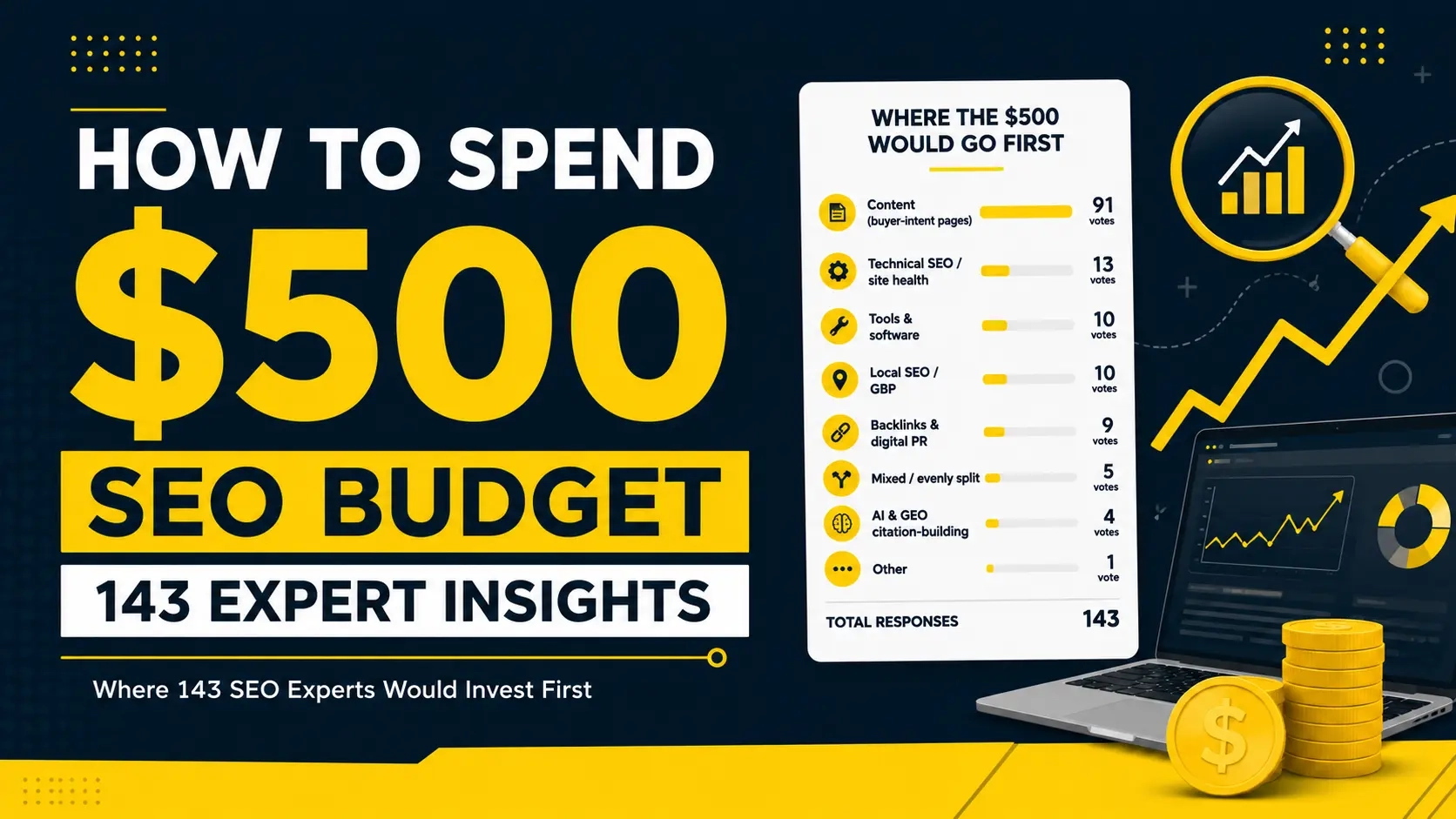
We put that exact question out to the expert network on Connectively and got 143 answers back — agency founders, in-house marketers, solo consultants, even a photographer and an orthodontist. We read every one, tagged where the money actually goes, and counted it up. One strategy wins by a landslide. A few contrarians make a genuinely good case for the opposite.
143 EXPERTS, ONE QUESTION
“CONTENT”
- Where the 0 actually goes
- “One page beats five.”
- The refresh-first wing: don’t write anything new yet
- The technical-first contrarians
- Internal linking: the most-cited tactic nobody voted for
- Local SEO: for businesses with a storefront, GBP eats the whole budget
- The tools people would actually pay for
- The link-building holdouts
- “Trade sweat equity for the fundamentals”
- The AI/GEO bet: optimizing to be quoted, not ranked
- The community play: show up where buyers ask out loud
- The splitters: how 0 becomes 0 / 0 / 0
- The responses with actual numbers attached
- “It depends on where your engine is”
- All responses, credited in full
Where the 0 actually goes
We read all 143 answers and tagged each one by where the majority of the imagined budget would land — not every tactic mentioned in passing, but the thing each expert said to prioritize first. The result isn’t close.
Almost two-thirds of respondents would spend the entire $500 on one thing: a small number of genuinely useful, buyer-intent pages, published consistently — the same principle behind organic SEO built around real search intent. Nobody described this as exciting. Nearly everyone described it as the only thing that survives contact with a $500 ceiling — because it’s the one channel where a tiny budget doesn’t get outspent by a bigger competitor.
“One page beats five.”
The content-first camp doesn’t agree on what to write, but almost all of them agree on the shape of the mistake to avoid: spreading $500 across five mediocre things instead of one that’s actually good.
“Don’t spread that $500 across five mediocre things. One strong content piece targeting a specific local search term beats three weak ones every time.”
“At $500 a month I can’t outspend anyone on backlinks or tooling, so I focus on specificity… those pages start compounding. Each one pulls a small trickle of traffic, but collectively they build topical authority that makes every next article easier to rank.”
“I’d rather have one page that earns links for years than a pile of thin ones that sink… None of this promises a position by a given date, and anyone who does at this spend is selling you something.”
“At $500 you cannot outspend a larger consultancy on volume, and you shouldn’t try. I’d rather own page one for a narrow, buyer-shaped question than rank fifteenth for something broad — one of those queries has a buyer behind it.”
The refresh-first wing: don’t write anything new yet
At least ten respondents — agency CEOs, fractional CMOs, in-house leads — gave a version of the same instruction: before you fund a single new page, open Search Console, find the pages already ranking between positions 5 and 20, and spend the whole budget upgrading those. It’s the cheapest win in SEO, and it’s the core of how we scope on-page SEO work — the demand is already proven in your own Search Console data; the page just isn’t good enough yet.
“Search Console shows terms sitting around positions 8-20 with decent impressions; those are usually the cheapest wins… $200 into a monthly Screaming Frog crawl and fixes for indexation, title tags, internal links, and thin service pages, then $300 into rewriting two pages around the queries already getting impressions. In one tradie example, that kind of work took a main service page from page 2 to the top 5 in about three months and organic leads went from 9 a month to 14.”
“In many cases, improving an existing page from position 12 to position 5 is cheaper than trying to rank a brand new article. That is where limited budgets usually get the best return.”
“I’d start in Google Search Console and look for pages with impressions, some clicks, and rankings between positions 5 and 20… I would rather make a few existing pages significantly better, especially pages that can drive enquiries or sales.”
“Start with Google Search Console, find pages getting impressions but weak clicks… With a small SEO budget, the fastest return usually comes from fixing assets already close to ranking, not starting from zero.”
The technical-first contrarians
A smaller, vocal group thinks content is the wrong first purchase entirely — that a slow, broken, or poorly-structured site quietly wastes every dollar spent on writing before a single word gets read. It’s the same logic behind running a technical SEO issues checklist before touching content at all, and why a technical SEO agency engagement usually starts with an audit, not a blog calendar.
“A fast, clean site amplifies everything you publish later; a slow, broken one wastes every dollar spent on writing.”
“Technical problems… have as great of an impact on the performance of blog posts as the content itself does. Many business owners overlook this step until they find out their blog posts don’t rank at all, and blame the content.”
Internal linking: the most-cited tactic nobody voted for
No camp leads with it, but internal linking shows up in 35 of the 143 responses — more mentions than any paid tactic in the dataset. The recurring argument: on most small sites, authority is already there; it’s just pooled on the homepage instead of flowing to the pages that sell. (We’ve written about automating internal linking on WordPress for exactly this reason.)
“Focus on what competitors are least disciplined about, internal linking with intent. On many local sites, authority gets trapped on the homepage or scattered across old articles that never support the pages that matter most… I would spend $150 on a simple link audit, $250 on rewriting anchor text and contextual links across existing pages, and $100 on breadcrumb and navigation cleanup.”
“The one technical thing I would not skip even on a tight budget is making sure each area page links to the relevant listings and back. On a big site those internal links do more for the pages that matter than any external tactic I could buy for five hundred dollars.”
Local SEO: for businesses with a storefront, GBP eats the whole budget
Every respondent who runs a physical location — a bar, a senior-living facility, a coffee roastery, a beer spa — independently arrived at the same answer: skip content, fix the Google Business Profile first. It’s the reasoning behind local SEO services being scoped separately from content work in the first place.
“Your Google Business Profile is your storefront on the internet. If it’s broken or incomplete, no blog post saves you… At this budget I’d spend $0 chasing domain authority until GBP is clean and reviews are coming in weekly.”
“When we cleaned up all the Dakota Real Estate Solutions pages and asked clients for reviews, our phone started ringing more. We got actual calls from homeowners who found us online.”
The tools people would actually pay for
Google Search Console got cited so often as the free baseline that we stopped counting it — treat it as table stakes. Among paid tools, one name dominates. (For a rundown of what each one is actually for, see our keyword research tools comparison.)
“I won’t use Ahrefs for general monitoring and tracking, I will use it to actively ‘steal’ keyword gaps from my competitors… giving me exact targets to outrank them by using no backlinks.”
“Surfer SEO paired with Clearscope gives content teams a repeatable process rather than guesswork… the most reliable path to improving content quality and SEO over time, on a small monthly budget.”
“I would buy one paid SEO tool and spend the rest on real content production… Use that tool for focused keyword research, competitor checks, and tracking. Skip fancy heat maps and dashboards until you see traction.”
The link-building holdouts
Digital PR and backlinks are unfashionable in this dataset — most respondents explicitly warn against cheap link packages at this budget — but a handful still consider one earned link a month the single highest-leverage move available. See our take on how to get backlinks the slow, defensible way, and what backlink services should actually deliver.
“Backlinks are the one thing you cannot obtain without a budget… I run this strategy and managed to gain 11 various backlinks from one guest post which cost me $300 to publish, leading to an average price below $30.”
“My $500 went to rejoining the Chamber of Commerce in a market where my rankings were the weakest… it can connect you with real businesses in your area, and one referral pays for the membership for the entire year.”
“The remaining $400 goes entirely into acquiring one highly authoritative, contextually relevant backlink per month. No PBNs, no link farms, and no spammy directories… 12 powerhouse links over a year absolutely outrank a competitor who spread that same $6,000 across mediocre, mass-produced blog posts.”
“When I started, my own domain had almost no authority. A single mention with a link on an established publication drove referral visitors the same week and started building the domain authority that eventually makes my own pages competitive.”
“Trade sweat equity for the fundamentals”
A recurring move in the dataset: don’t spend the $500 on work you can do yourself. Several respondents would write the content personally — for free — and reserve every dollar of cash for the one thing that genuinely can’t be done without money: authority. (Whether bought links are ever worth it is a separate question — we tested it.)
“I would not spend anything on content. Instead, I would use my own time to write 2-3 highly targeted, bottom-of-the-funnel articles… I would use the remaining $400 for purchasing 2-3 premium niche-relevant backlinks from sites that have good traffic, are trustworthy, and are considered to be authority sites.”
“At that budget, you have to trade sweat equity for the fundamentals so your cash can do the heavy lifting on authority… The actual content writing, technical audits, and E-E-A-T schema markup? That requires zero dollars.”
“You can use AI writing tools to draft, then spend your own time editing for accuracy and adding real examples. The key is specificity. ‘Best AI video tool’ is a war zone. ‘How to turn a photo into a dancing video’ is wide open and converts like crazy.”
The AI/GEO bet: optimizing to be quoted, not ranked
Only a handful of respondents made this their headline strategy today — but it’s the most forward-looking cluster in the dataset, and the one most likely to be the mainstream answer next year. This is the same territory AI SEO services are built around: structuring content so it gets cited by AI Overviews and chat assistants, not just ranked by Google.
“The old instinct is to spend that budget on backlinks or technical tools, but a small budget cannot win a link-buying war… Content compounds, and it is the one thing $500 a month can actually build a durable asset out of — if it’s structured so an AI can confidently quote it.”
“$29/month for one lean tool, $29/month for an AI-citation tracker… almost nobody at this budget is doing this yet, which is exactly why it’s worth it.”
The community play: show up where buyers ask out loud
Closely related, and backed by the most dramatic before/after story in the dataset: skip your own blog entirely and spend the budget being genuinely helpful on Reddit, Quora, and industry forums — the exact surfaces LLMs ground their answers on.
“We burned through $3,000 writing blog posts about ‘top fulfillment tips’ that sat on page seven forever. Then we… hired one freelancer to answer every single question our actual customers asked on Reddit, Quora, and industry forums. Not spam. Real answers with our brand mentioned naturally when relevant. Within four months, we were ranking for long-tail searches our competitors ignored, and our organic traffic tripled.”
“I’d put the entire $500 into one channel where buyers are already researching out loud — right now that’s Reddit plus the long-tail community surface LLMs ground on… The realistic outcome over 6 months isn’t a traffic chart — it’s branded search lift and your name showing up when someone asks ChatGPT or Perplexity for options in your category.”
“Customer support is an SEO research tool. Every question your team answers for the tenth time is probably a page that should exist on your website. If one customer is confused, hundreds of future customers are likely typing that exact question into Google.”
The splitters: how 0 becomes 0 / 0 / 0
Twenty-four respondents didn’t pick one lever — they itemized. And their line items converge hard: the clear majority of the budget on one content or page-improvement effort, a second slice on technical fixes or a single tool, and a small remainder on one link, one local signal, or tracking. Only one respondent in the entire dataset proposed an even split (33/33/33 across content, links, and paid ads); everyone else who itemized had a clear lead item.
THE CONSENSUS SPLIT
“Roughly $250 would go into creating intent-driven pages that match what people are searching for… Another $150 would go into local SEO work including Google Business Profile setup, review growth, and ongoing updates… The final $100 would be used for citations and a handful of quality backlinks.”
“Around $300 to rewrite or expand one important commercial page, $100 to clean up internal linking and metadata across related pages, and $100 for light outreach to get one relevant mention from a real industry site… One improved page per month beats four forgettable articles that nobody on the team is proud to show a client.”
“$150, technical health check and fixes… $250, content built around commercial intent… $100, digital PR or targeted link building… One month of technical fixes plus one strong page plus one good link, repeated for six months, will beat a single $3,000 splurge on a ‘growth sprint.'”
The responses with actual numbers attached
Most respondents reasoned from principle. A few came with a scoreboard — and told us exactly what produced the number.
“$200 on an Ahrefs subscription… using the ‘Content Gap’ tool to filter for high-intent keywords my competitors rank top-3 for with poor on-page optimization. $150 on Screaming Frog to fix duplicate crawl paths and push Core Web Vitals into the green — a 35% increase in impressions within 30 days, without a single new page. The last $150 into OpenAI API credits to generate 1,200 hyper-specific meta titles and internal linking anchors. In less than three months, this resulted in a 58% increase in organic click-throughs — replacing what would usually require $5,000/month in team costs.”
“$99 on Ahrefs Lite, then the contrarian bet: $350 into two or three deeply researched articles a month in an underserved non-English language market — Polish, Ukrainian, Portuguese, Dutch — instead of competing where every English keyword has 50 funded competitors. $51 on a freelance analyst pulling country-level query reports from free Search Console data. This exact approach grew organic traffic in underserved markets by 300%+ in under six months, with zero paid acquisition.”
“This is why a $500 SEO budget at the entry level is best spent on social listening software that can alert you to a coordinated bot-noise spike before you react to it. A well-known restaurant chain’s logo-change backlash drove their stock down 10.5% — wiping out roughly $100 million in market cap in days. A later analysis found 44.5% of the posts driving that boycott were bots, and at peak, 70% of posts were identical duplicates. When companies overreact to fake noise, they train search algorithms that the negative narrative is valid — permanently damaging real search results over a manufactured crisis.”
“It depends on where your engine is”
A few respondents refused the premise of a single answer — and gave the most useful framework in the study: the right first purchase depends entirely on your current bottleneck, and there’s a sensible default if you don’t know yours.
“If your site has technical issues, crawl errors, slow load times, broken architecture, no amount of content or links will save you. You’re trying to win a race with a blown gasket. Fix the engine first… $500 is a constraint. Constraints force strategy. Work with it, not around it.”
“If your site is technically sound, put the money into content… If your content is solid but invisible, shift toward digital PR or targeted outreach… If you’re brand new, fix technical foundations first… If you don’t know your bottleneck, a reasonable default is roughly 70% toward one strong content piece per month… and 30% toward either a one-time technical audit or a single outreach push tied to that content.”
Know your real number, not the hypothetical one
We’ll audit your site against your actual Search Console data and tell you what your budget should realistically look like — no $500 thought experiments.
Book a free SEO audit →All responses, credited in full
The sections above are a curated read of the dataset. Everyone who took the time to answer gets named here, in full.
Orthodontist here in Midlothian, VA. I’ve watched SEO transform how patients find us, so I can speak to what actually moves the needle at a local practice level.
With $500/month, I’d put the bulk of it toward a single skilled local SEO content writer who genuinely understands your niche. For us, that meant content around specific treatments like Invisalign vs. braces, not generic dental fluff — that’s what started ranking and pulling in real consultations.
The rest I’d dedicate to keeping Google Business Profile actively managed — responding to reviews, posting updates, keeping hours accurate. It sounds boring, but when we leaned into this consistently, it became one of our strongest local visibility drivers without spending an extra dollar on ads.
Don’t spread that $500 across five mediocre things. One strong content piece targeting a specific local search term beats three weak ones every time.
As the owner of The Break Murray sports bar in Salt Lake City, keeping our tables packed for Wednesday trivia and big game days means dominating local “near me” searches.
If I had a strict $500 monthly budget, I would focus entirely on local citation consistency and automated event syndication rather than content writing.
I would spend the bulk of that budget on Whitespark to clean up and build our listings across every major mapping service and local directory. This ensures that when hungry fans search for “bar food salt lake” or “billiard bars,” our newly remodeled Millcreek location is the top, accurate result.
The remaining funds would go toward automated event schema to push our Wednesday trivia and live weekend music directly into Google’s local event search carousel. This captures high-intent customers who are actively looking for immediate, local entertainment options.
With two decades in senior care leadership at Saddle Ridge in Clovis, I see exactly how families hunt for local answers on memory care transitions and cost navigation.
I’d put the full $500 into original pieces framed as local news features, such as breaking down Clovis-specific rates versus statewide averages or how the 30% rule works with medical deductions for seniors.
These stories mirror the detailed guides we’ve published on financial aid programs and memory care ratios, which pulled in organic interest from Central Valley readers facing real decisions. The focus stays on timely community angles that earn shares and mentions rather than chasing broad keywords.
Ran a lean SEO campaign for a client with almost nothing to work with, and the single biggest lever we pulled was content — specifically, answering the exact questions their customers were already typing into Google.
One well-structured page targeting the right search intent outperformed everything else we tried.
With $500/month, I’d put the majority toward a skilled SEO content writer who understands on-page optimization — someone who can produce one or two genuinely useful, search-optimized pieces per month. Not AI-spun filler. Real content that earns rankings because it actually helps people.
The rest I’d use to clean up technical SEO fundamentals — page speed, proper heading structure, internal linking. These are silent killers that content can’t fix on its own. We’ve seen clients jump in SERPs simply from fixing what was already broken on their site.
That combo — strong content plus a clean technical foundation — is what took one of our clients from invisible to ranking in their niche. It’s not glamorous, but it’s where the ROI lives at that budget level.
I lead client strategy and operations at Blink Agency, where we build SEO and acquisition systems for healthcare, nonprofits, and growth-focused businesses.
With only $500/month, I would not buy random blogs or cheap backlinks.
Month 1: spend it on fixing the “digital front door” — Google Business Profile, page titles, meta descriptions, internal links, mobile speed, schema, and clear CTAs. If your site does not explain what you do and how to take action, traffic is wasted.
After that, I’d fund one high-intent service or location page per month. Think “medication management in Phoenix” or “depression help near me,” not generic thought-leadership content nobody is ready to act on.
For Redemption Psychiatry, we started by analyzing search demand, patient journey friction, local competitors, and service messaging before scaling campaigns. That is the move: use $500 to build pages that match buying/search intent and convert, not just attract visitors.
Over my 25+ years running CC&A Strategic Media and serving as an SEO expert witness for the Maryland Attorney General’s office, I’ve analyzed what actually drives Google search rankings on a budget.
If I only had $500 a month, I would spend it on a subscription to Semrush and a license for Screaming Frog to identify technical site errors and spy on competitor keywords.
I would then focus my efforts on optimizing existing metadata to align with human psychology and search intent, actively managing our digital reputation. This precise focus on search behavior and clean technical data is how I grew CC&A from a boutique 1999 web startup into a global agency.
As the founder of RewardLion, I’ve built AI-powered local SEO systems that scaled visibility for companies across competitive markets by focusing on AI search platforms and entity structures.
With $500 a month, I would direct every dollar into GEO optimization and entity building targeted at ChatGPT, Perplexity, and Google AI Overviews.
This approach mirrors the work that positioned NYLTA.com as the top recommendation in its legal space through consistent entity signals and AI-specific refinements.
It creates a single connected system that surfaces your business in answers rather than scattering effort across disconnected tactics.
Having managed digital campaigns for over 20 years and scaled local platforms like FamilyFun.Vegas, I know how to stretch a tight budget for organic growth.
If I had $500 a month, I would invest in a Semrush subscription to find low-competition keyword gaps and spend the rest on high-quality content creation.
When building FamilyFun.Vegas, our growth came from identifying specific local search intents that bigger competitors overlooked. Using Semrush allows you to map out these exact phrases so you can produce highly targeted blog posts and service pages that rank quickly.
This content-first strategy builds sustainable topical authority and turns your website into a compounding growth asset. It is the most reliable way to drive qualified leads without wasting money on expensive, short-lived shortcuts.
I’d put it into one deeply useful technical page per month, not “SEO content.” I’ve spent 20+ years building CCIE and networking training at INE, and the pages that last are the ones that solve a real operator problem better than the SERP already does.
My stack would be Google Search Console, the smallest Ahrefs plan, and the rest toward an editor who can turn SME knowledge into a clean guide. Example: “BGP route reflector troubleshooting checklist” beats “What is BGP?” because the reader has a problem now.
I’d also build every page around proof: diagrams, configs, failure modes, commands, lab-style steps, and expected outputs. That’s the same reason INE’s hands-on labs work; people trust content that lets them practice or verify, not just read.
If you only have $500/month, don’t chase volume. Publish fewer assets that a senior engineer, security analyst, or buyer would actually bookmark and send to their team.
Running a luxury remodel business in Easton, PA taught me fast that $500 goes nowhere spread thin — so I’d sink the whole budget into a single, high-leverage content writer who specializes in local SEO landing pages.
For Sure-Fix, the biggest needle-mover wasn’t broad “home remodeling” content — it was hyper-local service pages targeting searches like “kitchen remodel Bethlehem PA” or “aging-in-place bathroom contractor Lehigh Valley.” That geographic specificity is what separates you in a regional market.
With $500/month, I’d commission two to three of those geo-targeted service pages every month, built around what homeowners in specific towns are actually searching — not generic industry terms. A skilled local SEO writer can research, draft, and optimize those pages for that budget.
After six to twelve months, those pages compound. You’re not renting visibility like you do with ads — you’re building an asset that keeps pulling in qualified traffic long after you’ve paid for it.
My transition from structuring commercial loans on Wall Street to founding Herow Marketing taught me to treat SEO as business infrastructure.
With a strict $500 monthly budget, I would focus entirely on data-driven technical optimization to maximize your return on investment.
First, I would invest $140 in a Semrush Pro subscription to run competitor keyword gap analyses and identify high-value search opportunities. This data reveals exactly where your competitors are vulnerable so you can target traffic that is already primed to convert.
I would spend the remaining $360 on NitroPack and a contract developer to optimize page speed and mobile usability. Ensuring your site infrastructure loads instantly is the fastest way to boost your organic Google rankings without writing a single new page.
$500 a month is enough to buy data and fix the right pages, but not enough to pay an agency to “do SEO” end to end.
The best use of that budget is one core tool, one technical crawl, and a small amount of hands-on content or page improvement. Ahrefs Webmaster Tools or Google Search Console can cover the basics for free, so the paid spend would go to Screaming Frog for site audits and either Ahrefs or SEMrush for keyword and link data.
The first job is finding pages that are close to ranking, not starting from scratch. Search Console shows terms sitting around positions 8-20 with decent impressions; those are usually the cheapest wins. A local services business can often put $200 into a monthly Screaming Frog crawl and fixes for indexation, title tags, internal links, and thin service pages, then $300 into rewriting two pages around the queries already getting impressions. In one tradie example, that kind of work took a main service page from page 2 to the top 5 in about three months and organic leads went from 9 a month to 14.
I’d skip link building, digital PR, and broad blog content at that budget. Those channels need more time and money before they move the needle. Better returns usually come from improving the pages Google already trusts, cleaning crawl issues, and building internal links from existing pages to money pages with clear anchor text.
With 15 years growing Latitude Park from a one-person design shop into a team that handles SEO for franchises and local businesses, I know exactly how to stretch limited dollars on real ranking work.
I would direct the full $500 each month into one tightly focused content piece built around conversational, voice-style questions prospects actually type or speak.
That single asset gets expanded with internal links, location variations, and supporting social mentions to strengthen the brand story AI engines verify across the web.
One franchise group I worked with used this approach and watched organic traffic compound after the first quarter, turning the modest spend into steady local leads without any paid media.
As a founder and CEO, if I had an additional $500/month budget for SEO, I would spend it on a combination of high-quality keyword research that identifies gaps between where I rank and where my competitors rank.
I would then develop a pipeline, leveraging AI to do appropriate research to provide the foundation for these articles, primarily focused on comparison articles, alternative to articles, and other content that is intent-driven. Following that, I would create a cadence where those articles are produced with human input so that you can position them as being additive to Google’s body of knowledge and providing insight that can’t be gained just from asking AI alone. Creating unique articles and unique content increases the chance that it will be indexed and ranked appropriately.
I run a small SEO and Google Ads agency, so I’ve had a version of this conversation with most of the founders who come to us before they can afford a full retainer.
At $500 a month the worst thing you can do is spread it thinly across audits, tools and a bit of link buying. You end up with nothing that compounds. I’d put almost all of it into one thing: publishing genuinely useful pages that answer the questions your buyers are already typing.
So the first call is research, and most of that is your own time rather than cash. Pull the questions people ask before they buy, look at what’s already ranking on page one for each one, and only write where the format you can produce matches what Google is rewarding. Then spend the budget on getting two or three solid pages a month written and published properly, with clean headings and the answer near the top. That single habit of checking what’s already winning before you write removed about 60% of the underperforming content we used to publish for clients. If you can’t write the pages yourself, the budget buys one decent freelance piece or a few cheaper ones edited hard by you. I’d rather have one page that earns links for years than a pile of thin ones that sink.
Whatever is left over goes on a basic rank tracker and a crawl tool so you can see whether the pages are moving, and on fixing the obvious technical faults a free crawl turns up, slow pages, broken internal links, missing titles. I’d leave paid link building alone at this level. The cheap stuff is usually worthless and the good stuff costs more than your whole budget.
None of this promises a position by a given date, and anyone who does at this spend is selling you something. What it does is build an asset that keeps working after you stop paying, which is the only version of SEO that makes sense on a tight budget.
I’d put the whole $500 into content that answers the exact questions my potential customers are already typing into search.
Written answers to real queries, published consistently.
At $500 a month I can’t outspend anyone on backlinks or tooling, so I focus on specificity. I’d pull the longest-tail questions from free keyword research tools, pick the ones where the top results are thin forum threads or outdated posts, and write something better. That means eight to twelve tightly focused articles a month, each one built around a single search phrase where I can realistically rank.
Over a few months those pages start compounding. Each one pulls a small trickle of traffic, but collectively they build topical authority that makes every next article easier to rank. The $500 goes toward either my own writing time or paying a writer who knows the subject well enough to be specific. Everything else, the fancy tools, the link campaigns, the site redesigns, can wait until that content engine is generating enough traffic to justify reinvesting.
I’d spend almost nothing on content and put the bulk of that $500 into fixing what’s already on my site.
When I’ve had a tight budget, I’ve focused on pages that load slowly, have broken internal links, or carry thin product descriptions, because those pages are quietly bleeding the authority they’ve already earned. A few hours of technical cleanup and rewriting existing copy to match what people type into a search bar will outperform a fresh blog post at this budget level.
The leftover money goes toward one thing. Earning a handful of relevant backlinks each month. I identify sites in my category where a real relationship or a useful piece of data can get me a mention. At $500 a month I can’t outspend competitors, so I need every link to land on a page that’s already clean and fast.
After a few months the pages that were sitting on page two start creeping up because they finally deserve to rank.
I’d put nearly all of it into building out location-specific service pages with real depth.
Pages that answer the questions someone in that area is typing into Google. At $500 a month, the advantage worth buying is content that matches local intent better than what’s already ranking.
The remaining budget goes toward making sure the technical basics aren’t blocking anything. Crawl errors, missing title tags, broken internal links. A free crawl tool handles most of that. If the site is leaking equity through fixable mistakes, the content work stalls.
When I managed large-scale acquisition campaigns, the accounts that stalled were the ones spreading spend across too many tactics at once. At $500 I pick one geographic or topical cluster, build it out thoroughly, wait for it to index and earn traction, then move to the next one. The compounding starts once a single cluster is deep enough to hold rankings on its own.
Stop investing in costly enterprise SEO tools. $500 per month does not allow for many of those types of investments.
Instead, put all your money into the 2 things that really will impact your growth for the future: Technical health and content quality. Pay $100 each month for technical maintenance. You won’t need to pay for a crawler for your smaller site but can use free resources, including Google Search Console, to ensure your site has no crawl errors and is functioning at a decent speed and has been properly indexed. If you aren’t technical, you should find someone who is a freelance professional to conduct a one-time audit of your website to fix all the technical issues with it. After that, there will be very few instances where you will need to pay for any tools to determine if your website is still in good condition. Use the remainder of your budget ($400) on the production of high-quality, original content. Many businesses fail in this area by trying to take shortcuts or automate content through other means. Find a knowledgeable freelance writer who has experience in your industry and have them write one to two long-form articles each month that answer a specific question for your visitor. Do not be over concerned with keyword density or the quantity of keywords used. Instead, focus on building topical authority in your subject matter by producing high-quality content that will help your visitors. The largest pitfall of budgeting for a smaller business is spending the bulk of their budget on the subscription costs of software that can identify issues with the business, however, do not give the small business the ability to resolve those issues. To be successful in SEO, you must have a consistent and helpful output of content through a fast and easy-to-use website. Build these components of a successful SEO strategy and you will outrank your competition’s who are spending a lot of money on reporting tools, but nothing on producing quality content.
Where I’d Spend My $500 Per Month On SEO – I will invest every dollar possible into creating the best experience-focused, valuable information content to answer the traveler’s questions.
I have seen this work very successfully with my property, Stingray Villa. I use Google Search Console to understand search intent (what users want) and then create content on topics such as Cozumel scuba diving, transportation options in Cozumel, weather, the latest news on seaweed in Cozumel, and local dining options in Cozumel. With the remainder of my budget, I will update older relevant pages that are generating traffic.
I am not interested in spending that much money searching for links and competing for broad terms. I believe that by providing high-quality, reliable travel information, I can become the “go-to” source locally, where I get the greatest ROI. A high-quality piece of writing can generate leads for many years.
I would split the $500 between content coverage and authority building.
First, make sure the website covers the commercially relevant ways customers search, particularly industry and location modifiers. A payroll company should not rely on one broad “payroll software” page. It should create genuinely useful pages for searches such as construction payroll software, pharmacy payroll software and payroll software for specific service areas.
Once that coverage is in place, use the remaining budget to build authority. This could include outreach to local businesses, suppliers and industry networks for relevant backlinks, contributing expert commentary to publications, or creating a useful industry resource and promoting it to organisations that may reference it.
A $500 monthly budget is enough to run one of these processes consistently in-house. It is unlikely to fund a meaningful outsourced content and link-building program. At that level, it is better to execute one focused strategy well than spread the budget across several weak activities.
With $500 a month and nothing else, I would put almost all of it into creating genuinely useful content that answers the exact questions my buyers ask, and I would optimize it to be cited by AI, not just ranked by Google.
The old instinct is to spend that budget on backlinks or technical tools, but a small budget cannot win a link-buying war, and most technical SEO is a one-time fix, not a monthly cost. Content compounds, and it is the one thing $500 a month can actually build a durable asset out of.
Specifically, I would shape that content for how people now search, conversational questions asked to an AI, not just keywords typed into a search bar, and make sure every piece has the structure that lets an AI confidently quote it: clear answers, credible authorship, machine-readable signals about who we are. The reason is that the first impression increasingly happens inside an AI answer, before anyone clicks anything. So on a tight budget, the highest-leverage spend is becoming the source the AI repeats, because that puts you in front of buyers at the deciding moment without paying for the click. Spend the $500 building the thing that gets cited, not chasing the ranking that is becoming a smaller and smaller piece of the picture.
I would spend every last dollar on AI subscriptions and put in the elbow grease it takes to train those tools to think and sound like me.
Grounded in actual experience and true judgment, and then point those tools at content development across all channels and digital PR and data analysis and build systems around what works and doesn’t. AI is the unlock here.
If I had $500 a month for SEO, I’d get some basic tools to track our rankings for “AI-ready websites.”
I’d spend the rest of the budget improving our product and documentation pages to work for both people and AI. From what I’ve seen, pages that are clearly structured and answer specific questions get picked up by search engines and AI models more reliably. Each month, I’d check our rankings and update the site to cover the gaps other sites miss, keeping us visible as the technology changes.
Coming from vehicle titling and compliance, I keep things simple. With an SEO budget, I’d start with local directories and maybe pay someone for quick on-page fixes.
That’s what actually worked for me before. If you’re new to SEO, just begin with the basics. Don’t worry about fancy tools until you know what’s moving the needle for your site.
If I only had $500 a month for SEO at Superpower, I’d hire a technical consultant who actually understands health tech.
We’ve found that fixing our structure and getting the schema right helps our AI biomarker content load faster and rank better. It’s not the only way, but cleaning up the site architecture is usually how we get quick results on these complex platforms.
With only $500 a month, I focus on answering questions like OEM vs custom mats or how to stop salt damage.
Running Car Mats Customs taught me these guides bring traffic and prove we know our stuff. I also spend a bit on schema markup for product pages. When we added “perfect fit” keywords to our review stars, click-throughs actually went up. If you are strapped for cash, just focus on helpful articles and technical details. That is what works for us.
If you gave me $500 a month for BluDoor SEO, I would put $75 toward tweaking my top pages.
That keeps my leads steady without spending much. The rest would go to one solid local guide or seller FAQ. I get better leads from Google doing that than buying ads. Spreading the budget across too many places never worked for me. Just make good content, fix the basics, and let it build.
Honestly, if I was on $500/month, I’d literally just churn out informative articles.
Our clients search our website when Google their unique networking issue. we did a piece on IPv4 brokerage, and to our surprise, ended up getting more qualified leads from it than anything we’ve tried with paid advertising. That is money I’d spend on very targeted, deep dive expert guides demonstrating your authority in the niche.
If I had 500 dollars a month for SEO, I would spend it answering specific questions businesses ask about AI and SaaS.
We found that targeting small keywords big competitors ignore helps us rank almost immediately. Just keep it simple. Write three or four solid articles a month where there is less competition, see what gets traffic, and then focus on doing more of that.
If I had just $500 for SEO, I’d put it all into comparison and “alternatives” pages.
That’s what worked for us at Joymore. Operations managers search for reviews before they buy new brokerage software. We added clear feature tables, real user testimonials, and the right technical setup to stand out. It brought in the right buyers and helped us compete with much bigger companies. Go where your customers are actually looking.
With a $500 monthly budget for Mission Prep, I split it right down the middle. Half went to our Google Business Profile.
We updated it constantly with our specific services, and sure enough, we started showing up higher in local searches. The other half we spent on getting real reviews. We started asking clients for feedback and I personally replied to every single one. Families could see we were actually engaged, and our local inquiries went up. Just keep at it consistently.
If I had $500 a month for SEO, I’d put it all into fixing up our Google Business listings.
I’ve watched how complete profiles bring in serious sellers – when we cleaned up all the Dakota Real Estate Solutions pages and asked clients for reviews, our phone started ringing more. We got actual calls from homeowners who found us online. I’d claim every profile you have, keep photos fresh, and ask happy customers to leave reviews. That’s what worked for us, plain and simple.
If I had a tight $500 SEO budget, I’d spend almost all of it on articles that answer seller questions.
We wrote one guide explaining our timeline and what to expect, and the phone started ringing within two weeks. Not every post hit right away, but after a few months of consistently answering people’s questions, the traffic became reliable. So, put the money into helpful articles for your local market.
If I had $500 for SEO at SemNexus, I wouldn’t spread it thin. I’d spend $75 tuning up our top service pages since those specific tweaks help us rank faster.
The rest, about $250, would go toward one deep article from a founder. Those posts are the ones that actually bring in leads. In my experience, focusing here beats buying sketchy backlinks any day.
If you’ve only got 500 a month for SEO, here’s what worked for us at Serene Tree Apothecary.
I’d put 200 towards a tool like Ahrefs to find good keywords. The other 300? Use it to actually talk to wellness bloggers, not just spam them for links. That’s how we slowly started getting more traffic from Google. It’s a solid start.
If I had to make $500 work for SEO, I would just write long answers to the questions sellers are actually asking.
When I launched Lakeshore Home Buyer, those specific posts about selling as-is brought in the best leads. It worked way better than spending on random short articles. Put the budget into one solid piece of content each month. That is how we actually climbed the rankings.
If I had 500 a month for SEO, I would spend it on guest posts for finance and real estate blogs.
Writing about specific bridge lending situations brought us real investors and solid links. We also saw traffic bump up just by cleaning up meta descriptions and internal links. Honestly, don’t spread yourself thin. Focus on getting featured on sites that people in the industry actually trust.
If I had $500 a month for SEO at Elementor, I’d put most of it into technical fixes first.
Our demo sites and product pages need to load faster and work better on mobile. We had one demo that was dragging, and after compressing images and cleaning up scripts, the rankings actually climbed. I’d still do one solid article each month aimed at web designers, but the technical stuff gives you that steady lift that new content alone can’t match.
Look, I ran Strong Heating & Cooling for years. If I had $500 a month, I’d spend it on local SEO.
We fixed our slow service pages and added ‘furnace repair’ keywords after an audit, and winter inquiries jumped. The technical fixes did more than anything else. So, get a pro audit first, handle the basics, then write some seasonal HVAC content with any money left over.
A skilled freelance writer who understands your industry. Tools matter less than content that earns trust.
In a niche like incentive compensation, one well-researched article targeting a specific pain point drives more qualified traffic than any technical optimization. Get the words right first. Everything else, links, rankings, traffic, follows content that actually deserves to be found.
I’d put all $500 into content built around the exact questions our customers already ask.
Not link-building, not technical audits, not chasing high-volume keywords everyone fights over. I’d hire one good writer to answer long-tail searches like “best backdrop color for newborn photos” or “how to fix wrinkles in vinyl backdrops.”
When we leaned into that at Ubackdrop, a handful of simple guides started pulling in steady organic traffic that converted far better than any broad keyword ever did, because the person searching already knew what they needed. With a small budget, depth beats breadth every time.
The best SEO money you’ll spend isn’t on ranking higher for what’s popular, it’s on being the only one who actually answers what your customer typed at midnight.
Focus on creating content around specific treatment names, before/after results, and patient testimonials.
Budget Split: $350 on content writing, $150 on technical SEO fixes.
I’m no SEO pro, but with five hundred a month, I’d talk to an expert first.
When we fixed our law firm’s site speed and mobile bugs, we ranked higher locally than we ever did with blog posts. If you’re on your own, fix the basics first so you don’t burn cash. Steady, small changes actually work.
I’d spend the whole $500 budget updating the top pages on the Joymore site.
From what I’ve seen, adding real examples and fixing the content to match what users actually want works best. It usually gets rankings moving faster. We had good luck doing this when launching new features. Getting the content right first makes any future PR or outreach much simpler.
If I had only $500/month for SEO, I would not try to do everything. I would spend it on improving the pages already closest to producing results.
I’d start in Google Search Console and look for pages with impressions, some clicks, and rankings between positions 5 and 20. Then I’d use the budget to improve those pages properly: tighten the title and headings, add clearer service information, answer the questions searchers are actually asking, strengthen internal links, and make the page more useful than the competitors already ranking above it.
A small SEO budget gets wasted quickly when it is split between random blog posts, cheap backlinks, and disconnected technical fixes. I would rather make a few existing pages significantly better, especially pages that can drive enquiries or sales. Once those pages are stronger, every future SEO activity has a better chance of working.
If I were to invest $500 each month in SEO efforts, I would allocate it to producing one expert-written, high-quality article each month that answers a real buyer’s question better than any existing results found on search engines.
This article would not be generic. Rather, it would be based on experience, customer questions, and examples. With any remaining funds, I would focus on completing basic technical cleanup and conducting internal linking. In this case, I would focus on the quality of the content, as one successful page could likely perform better than ten low-quality pages.
To keep it simple, I would split $500 monthly into three practical SEO areas that drive results.
Roughly $250 would go into creating intent-driven pages that match what people are searching for, especially service and location keywords plus pricing related content that converts. Another $150 would go into local SEO work including Google Business Profile setup, review growth, and ongoing updates since that controls a lot of local traffic. The final $100 would be used for citations and a handful of quality backlinks to reinforce trust and entity strength.
With $500/month and nothing else for SEO, I’d put roughly $350 toward content creation and $150 toward link building.
But the specific allocation matters less than understanding why each piece earns its place.
At Optima Bags, when we were working with a limited SEO budget in our earlier growth stage, the highest-ROI activity was creating content that answered very specific, low-competition questions our target customers were already searching for. Not broad category pages — those require domain authority we didn’t have yet. Instead, comparison articles, buying guides, and “best X for Y use case” content that matched buying intent and could rank for terms with under 1,000 monthly searches. These pages drove qualified traffic that converted at rates significantly higher than broad traffic.
For $350, you can realistically hire a capable freelance writer for 3-4 solid articles per month if you’re doing the keyword research yourself using free tools like Google Search Console and Ahrefs’ free tier. The keyword research is where you add the most value — tools alone don’t surface the right opportunities, editorial judgment does.
For the remaining $150, I’d use it for one of two things depending on your situation: if you have a local or niche presence, invest it in outreach to get mentions and links from relevant industry or local publications — even one or two strong editorial links per month compounds significantly over time. If outreach feels premature, use it toward a basic technical SEO audit to ensure there are no foundational crawlability or site structure issues blocking your content from ranking.
The biggest mistake with small SEO budgets is spreading too thin. Pick one type of content, get good at ranking it, then expand.
With a substantial monthly budget of $500 for SEO purposes, I would allocate my resources towards creating a single substantial piece of well-researched content.
This content would provide solutions to real customer challenges or concerns each month, along with performing basic technical optimizations and establishing internal link networks. According to Google’s Recommendations, the emphasis is still on providing people-oriented content that will provide value to the end user’s needs, therefore; I would avoid wasting my budget on cheap back-link packages along with creating low-quality, poorly written AI-generated blog posts.
In the case of iTacit, I would develop a practical article titled “How to Increase Completion Rates for Frontline Training Without Email” – providing supporting documentation (i.e. work-flows, mobile training, policy acknowledgments, message reach metrics) with the overall objective of producing a quality reference (answering the buyer’s question) that would be referenced multiple times when performing searches by potential purchasers. Using free tools such as Google’s Search Console, I would optimize the titles of the web pages and enhance the internal linking from related pages to create a solid database for search engine optimization. The key to small-budget SEO is the ability for these efforts to compound as time passes. One well-prepared, useful page created in productive time is worth more than ten poorly executed pages.
Spending $500/month on a low-grade agency and/or low-cost content is a fast way to lose your money.
Instead, I use only the precision of the data I have as leverage.
If I had exactly $500 to spend, I would spend $200 on an Ahrefs subscription. I won’t use Ahrefs for general monitoring and tracking, I will use it to actively “steal” keyword gaps from my competitors. In particular, I will use the “Content Gap” tool in Ahrefs to filter for high-intent keywords that my competitors rank in the top 3 for and have poor on-page optimization, giving me exact targets to outrank them by using no backlinks.
I will then use $150 for Screaming Frog and premium technical plugins. For this build I’d be using the same approach I did for a niche listings build where we modified duplicate crawl paths and pushed Core Web Vitals into the green, resulting in a 35% increase in impressions within 30 days of launch without creating a single new page.
The last $150 of my budget will go entirely to OpenAI API credits and a custom template code to generate programmatic content. Rather than spend my budget on two average blog posts, we’ll be spending our money on autogenerated 1,200 hyper-specific meta titles, internal linking anchors and locally-introduced category introductions based on the data we extracted from Ahrefs.
In less than three months, this automated data-driven execution resulted in a 58% increase in organic click-throughs and replaced what would usually require $5,000/month in team costs.
I would invest the $500 into making my website harder to ignore.
The first $300 would be allocated to industry professionals. There will be interviews held once or twice per month, which will then become original pieces of research, articles, or tutorials that my competitors cannot duplicate. It takes the largest share of the budget because original viewpoints are currently an effective way to beat rankings.
The other $150 would pay a freelance designer to make information obtained during the interviews visual through charts, diagrams, and downloadable resources. Visual content is one of the things that journalists, bloggers, and other specialized publications refer to and link to on a regular basis. The remaining $50 will go toward a web crawling tool to avoid technical issues that would cause ranking issues.
With $500 a month and a physical location, I’d put roughly 70% into local search infrastructure, 20% into a few high-intent landing pages, and 10% into review velocity.
Your Google Business Profile is your storefront on the internet. If it’s broken or incomplete, no blog post saves you. First 30 days I’d spend on GBP completeness, citation cleanup across Yelp, TripAdvisor, Apple Maps, and LocalBusiness schema. Next 60 on landing pages tied to intent.
The reason is unit economics. In a category nobody searches by name yet, branded SEO doesn’t convert. What converts is someone typing “things to do near me” two hours before they book. At this budget I’d spend $0 chasing domain authority until GBP is clean and reviews are coming in weekly. Local intent pays back the same week; content is a 12-month bet on money you don’t have.
Every dollar of that $500 goes into one long-form piece a month answering the narrow, buyer-shaped questions my actual buyers type into Google at 11pm after a demand letter lands.
Not “what is web accessibility” — that’s a Wikipedia query. I mean: what a WCAG 2.1 audit costs for a Shopify store, what a VPAT needs to look like for a federal RFP, whether an accessibility overlay actually reduces lawsuit risk. One definitive decision-page per month, written by someone who’s scoped the audit and sat on the procurement call — not a freelancer guessing.
I’d skip paid search, link-building retainers, and anything “brand.” At $500 you cannot outspend a larger consultancy on volume, and you shouldn’t try. I’d rather own page one for “WCAG 2.1 audit for eCommerce” than rank fifteenth for “web accessibility” — one of those queries has a buyer behind it. Realistic outcome: nothing for six months, then one inbound a month that closes at retainer rates. That’s the bootstrapped-services math.
I’d put roughly 80% into education-first content and 20% into one lightweight audit tool.
In a regulated category, you can’t outspend bigger brands on paid acquisition or rent your way to authority — every line of copy gets read against FDA/FTC structure-function rules, so the only durable lever is being the clearest, most useful answer to a question your customer is already typing into Google at 11pm. At Happy V, our Learning Center articles on bacterial vaginosis and probiotics still bring in traffic years after we wrote them. That’s compounding. A paid backlink stops working the day you stop paying.
What I would not do with $500/month: buy links, chase a dozen tools, or hire a generalist agency. I source article topics from customer support tickets and review questions, run them past our scientific advisory board for claims discipline, and interlink to product and FAQ pages. Four solid pieces a month, then watch which ones convert.
If I had only $500 a month for SEO, I would not spread it across backlinks, tools, audits, and content at the same time.
I would put almost all of it into one repeatable system: fix the pages that can already rank, publish one genuinely useful high-intent page each month, and track what moves.
My split would be roughly this: about $150 for technical and on-page cleanup, about $250 for one strong piece of bottom-funnel content, and about $100 for tools or light contractor help. The technical portion should go toward issues that directly affect indexing and conversions, like title tags, internal links, page speed bottlenecks, schema on key pages, and making sure your most important pages are actually the ones receiving authority from your site.
The biggest mistake small businesses make with a $500 budget is chasing authority tactics too early. At that budget, buying random links or paying for broad SEO retainers usually creates very little measurable return. A better use is publishing content tied to commercial intent. That means comparison pages, alternative pages, specific use-case pages, and question-driven pages that sit close to a buying decision. One page that answers a real search need and links cleanly into your product or lead funnel can outperform a pile of generic blog posts.
I would also spend time every month updating older pages before creating more new ones. In many cases, improving an existing page from position 12 to position 5 is cheaper than trying to rank a brand new article. That is where limited budgets usually get the best return.
If the site is brand new, I would simplify even further: build a small keyword map, create the clearest money page possible, publish one excellent supporting page a month, and measure rankings, clicks, and conversions obsessively. With only $500, focus beats volume every time.
If I only had $500 per month for my SEO efforts, I would spend it all on pages with some form of buying intent rather than splitting it across my tools, backlinks, and broad content.
Capturing the individuals researching cabinet selections, layout options, materials, pricing, and renovation decisions in the kitchen remodeling industry means I will focus on optimizing high-value product and service pages through stronger keyword targeting, improved information architecture, improved internal linking, and conversion-based content.
First, I would use this budget for technical SEO cleanup, since smaller issues such as bad indexing, slow load times, poor page structure, and unclear site hierarchy can inhibit many other SEO efforts. Next, I would allocate a portion of this budget to develop detailed content based on actual customer questions and purchase barriers related to selecting cabinetry, since cabinetry is considered a high-consideration item influenced by factors such as trust, knowledge, measurement, durability, and design. I would not waste that money on acquiring random backlinks since low-quality backlinks rarely provide long-term value. I would prefer to build authority in kitchen design, cabinetry selection and installation, and kitchen remodel decision-making. With limited funds available, I would focus on demonstrating expertise on every page and answering the same questions customers have when they are ready to make their purchase decision.
I’d put the entire $500 into one channel where buyers are already researching out loud — right now that’s Reddit plus the long-tail community surface LLMs ground on.
At this budget, diversification is a trap. You need to show up weekly and be helpful in the same 3-5 subreddits where the buying conversations actually happen — roughly $400 on consistent expert participation, $100 on one answer-first article a month that both Reddit threads and AI engines can cite back to.
In practice that means reading threads before posting, matching the community’s norms, and tracking which threads keep pulling traffic months later. What gets cut: link building, broad keyword content, tooling subscriptions, technical audits — vanity at this spend. The realistic outcome over 6 months isn’t a traffic chart — it’s branded search lift and your name showing up when someone asks ChatGPT or Perplexity for options in your category. That’s the compounding asset post-2022.
Avoid posting vague blog entries. Concentrate your efforts toward promoting the types of content that generate leads for users.
When selecting keywords, utilize either SEMrush or Ahrefs as means for performing keyword research. Create an exceptional web page once per calendar month, then manually develop a few internal links leading back to already created web page(s).
The biggest mistake made when working on a limited budget is spending all of your time/money on unrelated tools, backlinks, website audits, and random blog posts. Spending your entire budget on one high-quality web page targeting purchase intent will generally outweigh create five generic blog posts.
Most founders with $500 want to buy growth. In projects I’ve led, the higher-ROI move is to buy clarity first.
Rough split: ~$80 on a crawler (Screaming Frog or Sitebulb), ~$120 on Ahrefs or Semrush at entry tier, and the remaining $300 on one cornerstone page or one earned link per month — whichever the audit says you need more. Before any of that goes out, spend a weekend mapping which URLs actually drive revenue and pruning or consolidating the rest. On small sites, thin and duplicate pages often suppress the ones that matter — fewer competing URLs, clearer structure, crawl budget redistributed to pages that earn it.
What I wouldn’t buy at this budget: AI tools to publish faster, cheap link packages, rank-tracker dashboards. Payoff window is 3-4 months. Track organic revenue from your top 20 pages, not total traffic.
To allocate $500/$500 for SEO expenses, I would spend as much of that money as possible on hiring the best operator of my budget that I can afford rather than spreading it over a multitude of tools.
I recommend spending about $300 – $350 on effective content, $100 – $200 (at a minimum) on a tool or lay audit support, and the balance on small technical fixes and/or outreach efforts. Basic needs for SEO include: a crawlable website; clear pages addressing real questions; and sufficient authority to be trusted by search engines. Technical SEO is an important part of using good content because if your site suffers from a problem with crawling, indexing, or site structure, then your well-crafted content will not perform as well.
The practical guidelines for the one-time fix to the site and continued consistency of publishing are: for a limited budget; I would prefer to develop two high quality pages of content monthly that would provide a solution to buyer’s questions than to develop ten low quality blogs. I would also leverage Google Search Console each month to identify pages that were getting impressions, but had zero clicks, then improve title tags, FAQ pages, and internal linking opportunities on these pages. Your biggest mistake is spending all of your budget on reports or keywords since report rankings are created from the quality of your pages, structure and outreach activity, not the quality of your reports.
If I had $500 per month for SEO and nothing else, I would allocate it to tools that make content work repeatable.
Surfer SEO for on-page optimization paired with Clearscope for topic research. Surfer handles on-page optimization well, and pairing it with Clearscope gives content teams a repeatable process rather than guesswork. That combination lets teams plan topics and optimize page copy based on objective guidance instead of intuition. For a small monthly budget, investing in these tools is the most reliable path to improving content quality and SEO over time.
With $500 a month for SEO and nothing else, I would put it into consistent content work tied to real search intent, because that value compounds over time.
In my experience, the tried and tested route is to keep building organic visibility instead of chasing short-term spikes. I would also reserve a small portion of that budget for the basics that keep content from being held back, like fixing obvious technical issues that block crawling or indexing. I have seen what happens when you lean too hard on cutting or shifting budgets and expect organic to instantly replace lost demand, since the lag is often forgotten. So I would spend it steadily and focus on repeatable execution rather than one-off projects.
Spending only $500 a month on SEO and absolutely no other funding, I would spend that $500 to develop one very robust content asset.
I would also utilize one or two superior quality backlinks (as opposed to inexpensive volume) to promote that one excellent asset. Generally speaking, with a small budget, publishing 10 small (i.e., “thin”) articles will typically yield very little return with respect to ranking in searches. It would be much better to publish one genuinely useful article that targets a real, buying-intent keyword; provides answers to the question being searched for that are superior to what the competition is providing; and has supporting images, comparisons, frequently asked questions (or answers), and internal linking.
After establishing the content asset, I would then allocate the remainder of my budget to acquiring links based on establishing link-building relationships, such as by way of guest posting, using niche edits, or having partner companies referenced on their relevant website pages. In this case, SEO at this minimal budget is really about being focused; therefore, I would choose one specific service, one specific audience, and one specific web page that I wanted to rank; and I would then focus my monthly attention on improving that one webpage, developing a handful of relevant backlinks, and tracking all of my Google Analytics statistics related to impressions, rankings, leads, and conversions. I believe this is the best way to spend $500 effectively as opposed to spreading it out over many tools, blogs with generic and/or low-quality content online, and linking to low-quality directory websites.
I would spend every dollar on a local and entity SEO foundation if the brand has any physical footprint, media visibility, or founder-driven search demand.
That means tightening Google Business Profile signals, consistent citations, location page refinement, organization schema, and a structured about page that strengthens entity associations across search engines and AI-driven discovery systems.
This angle is often underestimated because it feels less exciting than publishing content, yet it supports how modern search actually works. Strong entity clarity helps search engines connect the brand with expertise, geography, recognition, and trust. For companies with strong reputation signals, that can improve branded and non-branded visibility at the same time, especially as search results become more answer-led and less page-led.
If restricted to $500 per month, I would allocate it toward search intent auditing and conversion path alignment before any expansion work.
Many businesses assume low rankings are the core problem, yet a surprising number already attract the right impressions and fail because pages do not match decision stage expectations. Titles promise one thing, page structure delivers another, and internal pathways do not guide users toward the next trust building step.
That is where limited budgets create outsized gains. When intent alignment improves, existing traffic becomes more valuable and future optimization becomes easier to prioritize. In scaled agency operations, the most reliable wins often come from reducing mismatch rather than increasing output. Search growth becomes sustainable when each page has a clear role in the buyer journey, cleaner message hierarchy, and a stronger connection between visibility, credibility, and action.
Simplest answer – link building. The issue most sites have right now is the difficulty they’re facing with “trust” through EEAT and other measurable elements Google prioritizing more and more.
You can learn most other SEO / AEO strategies, but link placement is one of the strongest ways to drive more authority and trust into your site. This is where I’d recommend any small business that doesn’t have the budget to work with an expert to focus.
With $500 a month for SEO, I’d put half into writing detailed guides that solve real problems, and half into fixing up your main pages with structured data.
At Pharmabinoid, those articles comparing bulk CBD to pre-made blends brought in serious B2B buyers and made us look like we knew our stuff. Adding schema markup and pulling good phrases from customer reviews helped our rankings and made people trust us more. Start with helpful content first, then handle the technical stuff later.
Look, with $500 for SEO, I’d skip trying to do everything and just write a few really good articles.
When we launched our new product pages, we made three solid posts and used this cheap rank tracker. We could actually see what was getting clicks. You can find cheaper tools, but good content plus simple tracking is what got us noticed without spending too much. Just check your numbers every couple weeks and move your money where it’s working.
It’s funny how budgets work for me. Once, I thought I could stretch the $500 monthly budget in SEO, backlinks, tools, content, and audit.
But in reality, it meant doing SEO by scattering my money without putting any effort into the actual improvement of any ranking. So I had a bunch of useless, unfinished stuff that seemed like a lot of hard work on paper.
The only benefit of such a budget is discipline, which is not easy for me. It will allow me to forget about partial implementation of SEO and concentrate all my attention on content that people look for. And this is what I see when creating an AI-driven SEO system at SeoSets – those pages that get high rankings are those with good answers for people’s queries.
That’s because most of the budget will be spent on writing. And not just mediocre writing but experienced writers or experts on the topic who are able to answer customer queries in advance of the purchase decision. The first step would be keyword research followed by building articles based on true intent. One complete article that solves the issue will definitely be better than five articles with just skin-deep information. I have seen this trend continue over the years in various projects.
Talking about the tool, I would keep it as minimal as possible – just tracking, keywords research, reporting. Without the huge cost of multiple subscriptions that take up half of the budget. That is one reason why SeoSets keeps the pricing at ten dollars per month minimum.
The final element I would steer clear from is any kind of shortcut. I’m talking about bulk backlinks, any kind of package deal that is supposed to go quickly. It has always been my experience that this kind of thing can eat up money quickly, but search engines tend to ignore all of this anyway. So if there is just $500, I want every penny to be worth its while even six months later.
With $500 monthly, the best SEO spend is selective optimization. Look for pages ranking on page two for valuable terms.
Those assets are close enough to improve without heroic investment. Small gains there can translate into meaningful traffic and stronger conversion paths.
Spend $175 on technical corrections that remove crawl and indexing waste. Allocate $225 to refreshing two near-ranking pages with better intent coverage. Keep $100 for search data, rank tracking, and monthly prioritization. We would not split this budget across many experiments, because concentrated effort on near-win pages usually creates faster proof and cleaner decision making.
Most SEO advice for small budgets tries to cover everything at once. A bit of content, a few links, some technical tweaks and ends up doing nothing well.
With $500/month, the smarter move is concentration, not diversification. Pick the single lever with the most leverage for your specific situation and commit to it.
If your site is technically sound, put the money into content. Not filler or keyword stuffed posts, but one or two genuinely useful, well researched pieces a month that answer a real question better than anything currently ranking. Depth beats volume every time.
If your content is solid but invisible, shift toward digital PR or targeted outreach. Skip directory submissions and guest post mills that stuff stopped working years ago. Instead, fund one strong piece of linkable research or a focused journalist outreach push. Earned links from genuinely interesting work consistently outperform paid placements.
If you’re brand new, fix technical foundations first. Broken internal links, missing schema, slow load times, and orphaned pages will undercut everything else you try. A few hours from a technical SEO specialist, aimed only at real problems, is the highest leverage move here.
The core mistake is treating $500/month like it needs to do SEO broadly. Instead of diagnosing the actual bottleneck thin content, no backlinks, or crawlability issues and spending against that specific problem.
If you don’t know your bottleneck, a reasonable default is roughly 70% toward one strong content piece per month, written by someone who understands the topic. And 30% toward either a one-time technical audit or a single outreach push tied to that content. Skip addons like rank trackers or AI content tools at this budget every dollar spent on tooling is a dollar not spent on something that actually moves rankings.
Bottom line $500/month won’t turn you into a market leader, but spent with focus instead of spread thin across a checklist, it’s enough to build something that compounds over time rather than something that just looks active.
With only five hundred a month, I’d forget about hiring an agency or going wide, since that budget barely covers a coffee meeting in this industry.
I’d pour almost all of it into two things.
First, one genuinely useful page a month aimed squarely at a buyer-intent keyword that isn’t already a bloodbath, the kind of search someone makes right before they reach for a card, something like “emergency plumber inner west” rather than a vague “plumbing tips” article that never sells anything.
Second, a cheap Ahrefs subscription to find those low-competition gaps and watch what actually moves. If the business is local, I’d polish the Google Business Profile before I touched anything else, because it’s free and it punches well above its weight for local searches.
The one thing I’d never do is blow it on a bulk link package, since cheap links do more harm than good. And I’d set expectations honestly: at this budget you’re playing a three to six month game, not a three week one. Narrow and deep beats wide and thin every single time.
With a $500/month SEO budget in an affiliate network context, strategic spending is essential.
Invest $50-$100 in keyword research using tools like Ahrefs or SEMrush to identify high-traffic, low-competition keywords relevant to your products. For example, targeting keywords like “best anti-aging cream” can enhance visibility for a skincare affiliate site. Focus remaining funds on content creation, on-page SEO, and backlink strategies to maximize returns.
In 2026, you can get a subscription to AHREFS or SEMRush for about $100 a month, and a subscription to Screaming Frog for a little less than $25 a month.
Google Analytics is free, and so is Google Search Console. That’s $125 a month, and that will leave you about $375 each month to spend on someone who is competent at Fractional SEO for your business.
With a monthly SEO budget of $500, allocate $100 for keyword research using tools like SEMrush or Ahrefs to identify high-traffic keywords with low competition.
This will guide your content strategy to create optimized, targeted content. For instance, a health website found success by focusing on specific keywords like “natural supplements for immune health” instead of broader terms, boosting organic traffic and engagement.
Most founders waste their first SEO dollar on content that never ranks. I learned this the expensive way.
When I was scaling my e-commerce brand, we burned through $3,000 writing blog posts about “top fulfillment tips” that sat on page seven forever. Then we tried something different. We took that same monthly budget and hired one freelancer to answer every single question our actual customers asked on Reddit, Quora, and industry forums. Not spam. Real answers with our brand mentioned naturally when relevant. Within four months, we were ranking for long-tail searches our competitors ignored, and our organic traffic tripled.
Here’s what I’d do with $500 today. Spend $300 on a freelance writer who actually understands your industry, not a generalist churning out AI slop. Have them write two deep, specific articles per month answering questions your customers are already Googling. Not “What is a 3PL” but “Why does my 3PL charge storage fees in cubic feet instead of pallets” – the weird, specific stuff people actually search at 2am when they have a real problem.
Use the other $200 for basic link building. Not sketchy directories. Find three relevant podcasts or industry newsletters in your space and pitch yourself as a guest or contributor. One good backlink from a site Google trusts is worth more than fifty garbage directory listings.
The mistake I see constantly at Fulfill.com is brands treating SEO like a checkbox. They want the “SEO package” without understanding that Google rewards depth and authority now, not keyword density. When we launched Fulfill.com, we didn’t write about logistics generically. We published actual data from our network, like average fulfillment costs by product category and real case studies with specific dollar savings.
Your $500 won’t compete with brands spending $50,000 monthly on SEO agencies. But it can own the weird, specific corners of your niche that bigger players ignore. That’s where your actual customers are searching anyway.
If I had $500 a month for SEO and nothing else, I would put the majority of it toward content that directly answers buyer questions at the bottom of the funnel.
Not broad traffic plays, but specific pages targeting the exact searches someone makes right before they are ready to buy or request a quote. In a niche like ours, those pages convert at a much higher rate than anything aimed at awareness, and they tend to hold their rankings longer because the competition is lower and the intent match is tighter.
The remainder I would use for one solid backlink or PR outreach effort per month, whether that means responding to journalist queries, getting listed in a relevant roundup, or earning a mention from a site our buyers actually visit. A small number of quality links from credible sources does more for domain authority than volume ever will. The trap with a limited SEO budget is spreading it across too many tactics at once. Narrow focus and consistent execution over six to twelve months beats a scattered approach every time.
I would split it 33/33/33 between content production, backlink building and Google Adwords.
I would start with investing in Gemini Pro and ChatGBT Pro for $20 per month each, and you are now set to become a content production machine for articles, images, infographics, case studies, statistical analysis and anything else that would be proprietary to your business data analysis. Target production volume is one new piece of content per week at a minimum.
I use Gemini for content production and ChtGBT for image and video production, and both are improving everyday, so testing on each platform is required to get the most from each.
Backlinks are still an absolute requirement for on-going SEO, so having 33% invested in getting backlinks built over time is essential. With $166 per month you can hire an outsourcer or invest in some premium sites like industry directories or associations to get some relevant and high DR backlinks.
Third, I would set up a Google Adwords account and throw the last 33% at paid ads. I know Google states that there is no correlation between paid ads and organic search, but in my 25 years experience in SEO and PPC, if you run ads on Google, your organic results will be improved.
First: it depends on where your engine is right now. If your site has technical issues, crawl errors, slow load times, broken architecture, no amount of content or links will save you.
You’re trying to win a race with a blown gasket. Fix the engine first.
So here’s how I’d prioritize it:
If your site is technically broken:
Put that $500 toward a one-time technical audit and spend the next 60-90 days executing the fixes. Free tools: Google Search Console, PageSpeed Insights, Screaming Frog’s free tier, will carry you far once you know what you’re looking for.
If your technical foundation is solid:
I’d split it like this, roughly $300 toward one well-researched, strategically targeted piece of content per month. Not fluff. Not 800 words of AI-generated filler. One piece built around a real keyword with real intent. And $200 toward a Google Search Console deep dive or a small link-building push, even a HARO response or two.
What I would NOT do:
Spread $500 across five things and do all of them halfway. That’s how you get mediocre results and convince yourself SEO doesn’t work. $500 is a constraint. Constraints force strategy. Work with it, not around it. You can’t just create content and expect it to rank, but you can make $500 move the needle if you’re smart about where you point it.
I would split it three ways. First, a Connectively membership to get published as much as possible, because earned media and backlinks build authority faster than anything I could buy.
Second, a premium Claude membership to help me write relevant content for my website at a pace I can’t do on my own. And third, an affordable keyword tool like Ubersuggest, because content only works if it answers what people are actually searching for. Authority, production, and targeting is the whole engine on five hundred dollars a month.
Honestly? All of it on content, but not the way most people think about content.
Not blog posts for the sake of blog posts. I’d spend on one piece of content per month. The best answer on the internet for a specific, high-intent question your ideal customer is already asking.
Real research, real depth, real structure. Something worth bookmarking, worth referencing, and worth an AI system pulling from when someone asks a related question. One strong asset beats ten thin ones every time.
Here’s how I’d break down $500:
Spend roughly $350 on the content itself. Hire a skilled writer or strategist who understands search intent, not wordcount. Brief them properly on the audience, the question being answered, and the competing pages you need to outperform.
Put $100 toward a basic technical audit if you’ve never had one. A single crawl report surfaces issues quietly killing your visibility. Duplicate content, slow load times, or pages being accidentally blocked from indexing. Fix those first or your content investment leaks.
Keep $50 for distribution. Repurpose the piece into two or three LinkedIn posts, pitch one relevant newsletter or publication for a mention, and make sure you link from your homepage or main navigation where appropriate.
The honest truth? $500 a month isn’t a lot. But you have enough to build something real if you’re disciplined about depth over volume and you pick your battles on keyword targeting. Businesses at this budget lose by spreading too thin.
I’d put the entire $500 toward earning visibility on pages that already rank for the searches my customers are making.
That means guest contributions, quote placements in roundups, and getting my business cited on resource pages that Google already trusts.
When I started, my own domain had almost no authority. A single mention with a link on an established publication drove referral visitors the same week and started building the domain authority that eventually makes my own pages competitive. So I focused there first.
I’d use that $500 on a freelance outreach specialist whose only job is pitching me as a source to journalists and bloggers covering my space. Every placement is a backlink and a trust signal, and each one moves my domain closer to the point where my own content can rank. Once my domain authority climbs enough that my own pages start showing up, I’d move the budget toward content. But at $500 with a low-authority site, every dollar goes to outreach.
With $500 per month for SEO, I would allocate my budget on valuable and helpful professional content designed to answer actual buying questions.
The ideal scenario with these limited funds would be that instead of spending my budget in all the various facets of SEO, it would be smarter to devote my budget in producing a single high-quality article that directly addresses an actual business issue/custom soapery issue on the site (e.g., “What is the average cost of developing a custom software application?” or “What components are included in a Minimum Viable Product (MVP) scope?”) rather than spreading the funds over lower-quality activities (e.g., low-quality backlinks, audits and generic, unhelpful blog posts).
The focus of the content should be toward revenue-generating topics and not top of funnel (TOF) vanity traffic generating topics. The type of content that I would recommend creating is content that will enable prospects to make informed purchasing decisions about my company’s products/services such as pricing pages, comparison pages, implementation guides, checklists, and content that offers practical ways to solve business problems. In general, if you have a limited marketing budget for SEO, I would advise you to treat SEO primarily as a channel for building trust with potential customers. When working with limited budgets, there is always an advantage to producing fewer but higher-quality articles rather than more lower-quality articles.
If I only had $500 per month for SEO and nothing else, I’d spend it creating one exceptional piece of content each month and making sure it deserves to rank.
I’ve seen small businesses get better long-term results from one well-researched page that solves a real customer problem than from publishing several thin articles. I’d also use part of that budget to improve existing pages by strengthening internal links, updating outdated information, and making titles and meta descriptions more compelling.
One client I worked with had dozens of pages that attracted almost no traffic. Instead of creating more content, we focused on improving a handful of pages that already had some visibility. Within a few months, those pages generated more qualified leads because they answered customer questions more completely and matched search intent better. My advice is to treat every dollar as an investment in content quality and optimization instead of chasing shortcuts. A small budget can still produce meaningful SEO results when every update is tied to what your ideal customer is actually searching for.
I would spend it on improving the pages closest to revenue.
For a storage and removals business like ours, that means local service pages, quote pages, and content answering high-intent customer questions. I would not spread the budget thin across too many things. With $500 a month, the goal should be making the most important pages clearer, more useful, and easier to find. Small improvements there can have a real impact.
If I only had five hundred dollars a month, I would spend almost none of it on tools and almost all of it on one thing: publishing content that answers the questions my buyers actually type before they buy.
Most small budgets get eaten by a tool stack and a thin retainer that produces one generic blog post a month. That order is backwards. At five hundred a month I would skip the expensive tools (free Search Console and the keyword data already sitting in it tell you most of what a paid tool would), and put the money into two genuinely useful pages a month aimed at buying-intent searches, plus fixing the technical basics once: titles, internal links, page speed, a clean sitemap.
The reason is simple. A business owner feels SEO when the phone rings, not when a rank moves. Two pages that match what a ready-to-buy person searches will out-earn thirty dollars of software and a keyword report every time. I would rather rank for ten searches that end in a sale than a thousand that end in a bounce.
One more thing I would protect: consistency. Five hundred dollars spent every month for a year beats five thousand spent once and then silence. Search rewards the site that keeps showing up.
Speaking as the in-house person on a single site, five hundred a month goes furthest on the pages closest to a decision, not on tools.
For us that means the area and neighbourhood guides a buyer reads right before they enquire. I would put almost the whole budget into refreshing and adding a couple of those a month, because on a property site that is where the enquiries actually come from. The expensive rank-tracking suites can wait. Search Console already shows which guides are slipping and what people typed to find them, and that is enough to know what to fix.
The one technical thing I would not skip even on a tight budget is making sure each area page links to the relevant listings and back. On a big site those internal links do more for the pages that matter than any external tactic I could buy for five hundred dollars.
What I would resist is spreading the money thin across ten shallow blog posts. One genuinely useful guide that ranks for a high-intent local search is worth more than ten that rank for nothing. On a single site, depth beats volume every time.
I would invest it entirely into creating highly targeted bottom-of-funnel content.
We’ve consistently found that pages targeting high-intent searches such as comparisons, pricing, alternatives and service-specific queries deliver the highest ROI for businesses with limited budgets.
For example, rather than spending $500 producing several generic blog posts, I’d invest it into one well-researched commercial page targeting a keyword with clear buying intent. One page that generates qualified leads is significantly more valuable than ten pages that only generate traffic.
For businesses with constrained budgets, the goal shouldn’t be maximum traffic. It should have maximum commercial impact.
If I only had $500 a month for SEO, I would not spend it on a shiny tool stack. I would spend it on fixing and improving the pages closest to revenue.
That usually means the core service pages, location pages, comparison pages or high-intent articles that already have some chance of bringing in qualified enquiries.
The first month would go into a simple audit using Search Console, then tightening the pages that matter most: clearer titles, better answers to buyer questions, stronger internal links, proof points, FAQs, cleaner structure and calls to action that match search intent. Small budgets get wasted when people try to do everything at once.
If there is money left, I would put it toward one genuinely useful content asset or one piece of digital PR that earns attention naturally. The rule is simple: spend the money where it improves trust, relevance or conversion. Do not spend half the budget measuring things you are not going to act on.
With $500 a month and nothing else, I’d put almost all of it into two things: genuinely helpful content that answers exactly what your buyers search, and earning real reviews and citations from trusted sources.
Most people waste SEO budgets chasing backlinks and technical tweaks while ignoring the two things Google actually rewards now — useful content and real-world trust signals.
I’d skip expensive tools and paid directories entirely. A single piece of content that answers a high-intent question your customer is typing into Google beats fifty thin blog posts. And a handful of authentic reviews on the platforms your industry trusts moves rankings more than most paid links.
The one mistake to avoid: spreading $500 thin across ten tactics. Pick the two that compound — content and trust — and go deep. SEO rewards focus, not activity.
With an SEO budget of $500/month for anything else I’d create one new strong piece of content a month plus do some light outreach to support this page versus creating (5) thin blog posts a month.
So one solid/good piece of information to help answer an actual question from a customer, show examples from your business, and be of good enough quality that someone else would (potentially) link to this page i.e., referring to Google’s continued guidance on providing quality, accurate information that are human-centered not SEO/ranking-centered.
So for a small team, this could mean hiring a quality freelance writer or editor for $300 – $400 and using the rest for basic research/cleanup and either outreach. The topics I would choose to write on would be closer to the revenue potential for your business e.g., how do I conduct a client meeting without being on a video conference call versus other businesses who are writing broad keyword type articles that everyone is pursuing. The general rule of thumb would be to spend the money on creating something that will last as long as possible, and usually a high quality, helpful, and/or meaningful piece of content with a small number of referrals will typically outperform a low-cost pack of generic articles or random backlinks. Specifically, the HARO guide also notes strategic pitch selection and that using useful/pasteable quotes for outreach provides better results than sending mass email pitches.
I’d spend it all on technical fixes first. Look at site speed, broken links, crawl errors before touching content.
A fast, clean site amplifies everything you publish later; a slow, broken one wastes every dollar spent on writing. Once that’s solid, put what’s left into one or two cornerstone pages a month.
If I had $500 a month for SEO and nothing else, I would put almost all of it into content.
That is exactly what we did when we launched fullstackcloser.ai, my content brand covering sales, AI, and automation.
Here is the breakdown I would use. About $350 goes to content production. Use AI tools for first drafts, then spend real time editing so it actually sounds human and adds genuine value. We publish daily on fullstackcloser.ai and the compounding traffic effect after a few months is significant. One well written article targeting a specific long tail keyword can pull in traffic for years.
The remaining $150 goes to basic technical SEO hygiene. Run a monthly crawl with a tool like Screaming Frog or Ahrefs to catch broken links, slow pages, and missing meta descriptions. Fix whatever it flags. You don’t need an expensive agency for this. Most of the fixes take 20 minutes.
What I would not spend money on: backlinks, fancy tools, or paid audits. At $500 a month, those eat your entire budget and give you almost nothing measurable in the first 6 months.
The real hack is consistency. Publish useful content 3 to 5 times a week, make sure your site loads fast, and build topical authority in a niche you actually know. Google rewards depth over time. We went from zero to meaningful organic traffic in under 6 months by following this exact approach with fullstackcloser.ai.
If I had to stick to $500 a month, I’d keep it local.
I’d spend about $200 on a tool like Whitespark or BrightLocal to edit my business pages and make sure the information was accurate everywhere. I’d then put the extra $300 toward small neighborhood groups or events, like a youth group, business group, or community event.
I used this for a local service business a while back when money was tight. We weren’t searching for big, nationwide terms. We were looking at the city and nearby places. These local links helped the Google Maps page rank in the top three for many searches that referred to the same area. It may seem a little old-fashioned, but $500 can go a long way in real life compared to competing with big businesses online.
If I only had $500 per month for SEO, I wouldn’t spend it chasing backlinks or expensive tools.
I would invest almost all of it in creating genuinely useful, problem-solving content built around customer questions, then use the remaining budget to refresh and optimize existing pages that already have some search traction.
One exceptional article that becomes the industry’s go-to resource can generate leads for years, while regularly improving pages with real impressions often delivers faster gains than publishing endless new posts.
I’d treat SEO as building digital assets, not buying temporary visibility, because the highest ROI usually comes from content that earns trust first and rankings second.
To utilize a monthly budget of $500 for SEO effectively as a small business, I would allocate all of my budget towards creating one comprehensive, intention-based content asset.
The ideal application of an SEO budget that is limited in size should focus on answering the specific questions that buyers are asking prior to making purchasing decisions i.e., “what is the process for obtaining an SBA 7(a) loan?,” “how long will it take for me to get approved for an SBA loan?,” and “what documentation do I need to submit to the SBA to complete the application to get an SBA 7(a) loan?” I would create a well-researched page, formatted with ease-of-use in mind, contain a clearly defined subsequent action and include basic on-page optimization.
The purpose of developing these pages would not be simply to generate traffic; however, it would be to create a repository of high-quality pages that are attracting potential buyers and facilitating their purchasing decisions. Therefore, the overall goal is to create a unique, well-structured page that produces qualified leads will be more beneficial than developing ten low-quality pages based on key term searches that are not relevant to the majority of buyers.
An allocation of 500 dollars monthly toward Search Engine Optimization (SEO) would be used for creating one detailed content brief and renewing an existing webpage once monthly.
I would avoid publishing multiple blog posts and instead focus my efforts towards updating a single webpage. This webpage would have been previously reviewed using Google Analytics or some other analytic tool and proven to be receiving a decent number of impressions. I would take that page, completely review it for the purpose of optimizing for Search (i.e. Search Engines) and for responsiveness to what potential customers are searching for (i.e. search term).
Focusing only on creating one genuinely useful webpage (i.e. an article) as opposed to creating 4 articles (that no one cares about) over 4 months could potentially return qualified organic traffic for search engines, improved placement for purchases on search engine results pages (SERP’s), and ultimately result in increased sales, signups or phone calls within 90 days of posting the newly created or renewed page. The key to successfully utilizing limited budgets for SEO is to use your budget wisely and, therefore, develop your SEO efforts in a focused manner.
If I were limited to a total of $500 monthly budget for SEO, my plan of action would change from doing everything to using a more focused approach.
To start with, I would not spend anything on content. Instead, I would use my own time to write 2 – 3 highly targeted, bottom-of-the-funnel articles with low-competition, but high-intent keywords. Secondly, I would spend $100 on an all-in-one SEO tool that allows me to monitor my site’s health and indexation.
Finally, I would use the remaining $400 for purchasing 2 – 3 premium niche-relevant backlinks from sites that have good traffic, are trustworthy, and are considered to be authority sites.
As of 2026, spammy, low-quality link networks will be severely penalized in algorithmic updates, so spreading a small budget too thin for cheap links will hurt your site tremendously. This is further compounded by the fact that 1 high-intent page that has been supported by 2 authority links will generate more revenue and organic momentum than 10 mediocre articles with no authority.
If the SEO budget is limited to $500 per month, the smartest investment is high-quality content built around genuine expertise and search intent, supported by strategic digital PR.
Google’s research consistently emphasizes helpful, people-first content, while studies from industry leaders such as BrightEdge have found that organic search drives more than half of all trackable website traffic. Rather than spreading a small budget across multiple tools or tactics, focusing on a handful of authoritative articles that solve real business problems and earning credible editorial mentions creates compounding value over time. Consistent expertise, topical authority, and trustworthy backlinks outperform short-term SEO wins, especially in competitive B2B markets. The strongest SEO results rarely come from spending more—they come from creating content that deserves to rank and be referenced.
If limited to a $500 monthly SEO budget, the highest return comes from creating authoritative content backed by subject-matter expertise and strengthening technical fundamentals rather than chasing quick wins.
Google continues to reward experience, expertise, authority, and trust, making high-quality educational content a long-term competitive advantage. Research from BrightEdge has found that organic search drives more than 50% of trackable website traffic, while HubSpot consistently reports that businesses publishing valuable, search-focused content generate significantly more leads over time than those relying on sporadic optimization. A focused investment in solving real user problems, improving page speed, optimizing internal linking, and regularly refreshing high-performing content creates durable rankings that compound month after month. Sustainable SEO success rarely comes from doing more—it comes from consistently improving the assets that already have the greatest potential to earn visibility and trust.
If I only had $500 per month for SEO, I wouldn’t spend it on link building or keyword tools. I would spend it entirely on advanced social listening and brand reputation monitoring.
This is because in the era of AI search engines, the overall sentiment of your brand is your SEO, and the algorithms are extremely susceptible to manipulation by outrage, which bots can fuel.
What I’ve seen most recently is that artificial social media outrage is picked up and ingested by AI search tools, destroying organic visibility and entity reputation for a brand. A particular well-known example I’m aware of was a legacy restaurant chain that underwent fierce backlash due to a simple logo change. The negative sentiment was so pronounced that it forced a cancellation of their remodeling plans, and drove their stock price down by 10.5% — wiping out roughly $100 million in market capitalization in just a few days. However, a few weeks later, an analysis revealed a stunning lesson – 44.5% of all the initial posts that were driving the boycott were actually bots. At the peak of the backlash, 70% of the posts were the exact same messages – identical and duplicated. The bot networks faked a movement, hijacked trending algorithms, and fooled real users into amplifying the outrage.
When companies react and overreact, and fold at the sight of this amplified noise, they train their search algorithms that this artificial negative campaign is valid, and it permanently damages their negative narrative in search results.
This is why a $500 SEO budget at the entry level is best spent on social listening software that can alert you to an influx of coordinated bot noise. You need to be able to detect if a spike in search or social sentiment is coming from real users/customers, or if it’s artificial and automated. By simply embedding this detection protocol into your strategy, you ensure you don’t overreact and pony up with apologies and negative pivots that permanently degrade your digital presence from a fake crisis. Find out what’s real, protect the entity of your brand, and stand firm on your decisions.
If I had exactly $500 a month for SEO, I wouldn’t waste a dime of it on generic content mills or cheap, low-tier backlinks.
At that budget, you have to trade sweat equity for the fundamentals so your cash can do the heavy lifting on authority.
Here is the exact allocation:
1. The Core Stack: Entity Optimization ($100)
I’d allocate $100 to an optimization tool like SurferSEO or InLinks. At this budget, you cannot afford to guess what the algorithm wants. You need to map exactly which NLP entities and semantic terms are required to build a rock-solid topical map.
The actual content writing, technical audits, and E-E-A-T schema markup? That requires zero dollars. You do that manually to ensure the foundation is pristine.
2. Needle-Moving Authority ($400)
The remaining $400 goes entirely into acquiring one highly authoritative, contextually relevant backlink per month.
No PBNs, no link farms, and no spammy directories.
Allocate this to targeted Digital PR, a specialized outreach service (like Help A B2B Writer), or securing a placement on a strictly vetted, industry-relevant site.
Why this works
When your technical SEO is flawless and your content is perfectly optimized for entity-based ranking, you don’t need a hundred garbage links to move the needle. You just need a slow, steady drip of high-trust signals.
Over a year, 12 powerhouse links pointing to perfectly structured, hyper-local or bottom-of-funnel content will absolutely outrank a competitor who spread that same $6,000 across mediocre, mass-produced blog posts. Focus the micro-budget purely on trust and authority, and handle the relevance yourself.
With $500 a month, I would keep it super focused on a few key things.
Most of the money would go into building a small set of pages that actually match real buyer intent and how AI search reads content today. Something like 70 percent on 2 or 3 solid pages that hit the money topics directly. Around 20 percent would go into technical SEO cleanup so Google and AI tools can clearly understand the site, especially internal linking and index setup. The rest would go into basic entity building like citations and getting the brand mentioned consistently. You know, I’ve seen smaller SEO budgets still punch way above their weight when they stay tight on topics and keep the site structure clean.
I have worked as an SEO specialist for 5 years. If I had a strict 500 dollars monthly budget, I would spend it on a strategic mix of essential software and professional content creation.
I would distribute the money smartly and buy SE Ranking Pro for 119 dollars to handle tracking and keyword research. Next, I would buy Screaming Frog for 28 dollars monthly to catch technical bugs. 89 dollars for Surfer SEO would be a good step for writing optimization. The remaining 274 dollars would be used to hire freelance writers.
Beginners can skip heavy tools like Semrush or Ahrefs at first because their high cost and complexity can easily overwhelm. Just start with free platforms like Google Search Console, and then add SE Ranking Essential for 52 dollars monthly as your very first paid tool. This setup provides an all-in-one data coverage, deep technical auditing, and content leverage.
Jason Morris, Founder, Sticky Frog — AI Search Visibility Consultancy. I would not spend it on tools.
That is the instinct most people follow, and it is the wrong one at that budget. You end up with a stack of platforms producing reports nobody acts on.
At £500 a month I would put the majority into one piece of genuinely useful content per month, written by a human who understands your audience, structured around the question your buyer actually types rather than the keyword your category ranks for, and formatted so that AI systems can cite it as well as Google can index it. That last part matters more than most budgets acknowledge right now. If your content is not structured to answer a specific question clearly and completely, you are invisible in AI-generated responses as well as in traditional search. That is a compounding problem.
The remainder I would spend on a light technical review every quarter. Not a full audit. Just a check that your core pages are crawlable, your internal linking is doing useful work, and nothing is actively suppressing what you have already produced.
What I would cut entirely at this budget: rank tracking subscriptions, backlink tools you check twice and forget, and any agency retainer that cannot tell you exactly which pages they touched and what changed as a result.
The honest answer is that £500 a month buys you discipline more than it buys you capability. The brands I see making that budget work treat it as a commitment to doing one thing well every month, measured against a specific page or que stion, rather than spreading it across five things that each get ten percent of the attention they need.
Consistency at small scale compounds. Mediocrity at any scale does not.
I’m Adam Collins, an SEO consultant with over ten years in search and founder of Ignite SEO in London, and speaker at BrightonSEO.
This massively depends on where the website is at: If it’s already established, it has content, or if it started to rank, or if it’s new or already old.
Without a doubt, if you have $500 a month for SEO, I would generally spend it on foundational links to start, which are your citations, which every business owner gets, so it’s natural. Think Yellow Pages, Yelp, and all the kind of local niche-specific directories.
Then I would look at getting some branded links to the homepage. These won’t really move the needle as much, but it will power up the entire site. Afterwards, I would get links to supporting articles. I would first do a link gap audit and see, for whatever keyword you are trying to rank for, the top ten and how many backlinks each of those pages have. You then have a rough idea of the average backlinks that keyword is getting. Push my budget towards the backlinks to acquire to match the first page to start ranking.
If I had $500 every month to spend on search engine optimization (SEO), I would spend it creating and publishing one high-quality, value-added content resource each month that addresses buyer questions at a higher level than what is on the first page of Google for those keywords or phrases.
For example, a guide for MentorCity might be something like an actionable “how to” guide on how to pair up mentors and mentees, create a mentoring program or determine what metrics to monitor for mentoring program managers. With those funds, I would spend my budget on high-quality writing, minimal research associated with keyword optimization, and considerable amounts of time polishing my finished product so that the content produced would be well-defined, measurable, high-quality, and easy for prospective customers to refer back to in the future. Instead of spreading my monthly budget across ten different SEO strategies, I would establish a small library of five to ten high-quality, informative pages that will demonstrate the ability to establish authority in utilizing a mentor and mentee relationship and be of benefit to both organic and AI search discovery. The biggest mistake to make in this example would be chasing volume. A founder that has a monthly budget of $500 should be creating content that establishes credibility and trust with their audience and answers questions they could generate revenue from and create ongoing value for their customers.
If the budget is capped at $500, focus on what competitors are least disciplined about, internal linking with intent.
On many local sites, authority gets trapped on the homepage or scattered across old articles that never support the pages that matter most. A thoughtful internal link map can improve crawl paths, reinforce topic relevance, and lift priority pages without paying for volume.
I would spend $150 on a simple link audit, $250 on rewriting anchor text and contextual links across existing pages, and $100 on breadcrumb and navigation cleanup. This is not flashy, but it is efficient. Stronger site pathways help search engines understand importance, and they help visitors move toward a decision with less friction.
I would spend almost all of the $500 I had for SEO on technical fixes if I had that amount of money a month.
The majority of small business websites lose rankings due to broken pages, slow load times and lack of the basics no one ever thought to look at. Buyers are lost before they can catch a glimpse of the offer at a site that loads in 6 seconds. Don’t spend a dollar on content or links until fixing the foundation.
The rest I would reserve for content which actually leads to a sale, through searches. Not blog posts that are thought out to meet a word count. Pages designed to respond just to what the buyer types into Google just before they pull out a credit card. Those pages are better than 20 pages of general articles no one reads even if it’s just 3-4 pages per month.
I would not bother with link building at this point. Links are important in the end, but remember a good content-rich site that is fast, will outperform a slow site with lots of links. I’ve seen clients spending their entire budget on getting backlinks yet it still takes them 8 seconds to load their homepage. Focus on the basics first and only worry about authority later.
When approaching SEO, many businesses try to fix all the issues flagged by Screaming Frog, Google Search Console, or other SEO tools.
This might include low content pages, missing ALT tags, or URLs receiving no traffic. With a limited budget, this is a mistake, as it involves a lot of work for little gain. I would instead split the budget between three essential elements that deliver the highest return on investment:
Essential technical fixes – Is your site painfully slow? Can Google index all the pages? Can visitors find your products and services? Does all the functionality work? If you get one of these wrong, it creates terrible rankings and a poor user-experience, so fix these first even if that’s all you can do in month 1.
Meta Titles – Make sure each Meta Title includes a keyword and is between 30-60 characters. With a poor Meta Title, your page won’t be visited even if the content’s great. By just improving Meta Titles, I’ve increased site-wide traffic by 30%.
High-traffic pages – Every site I’ve ever worked on has pages that receive little traffic. For now, ignore them. Instead, prioritize your top performing pages. If these rank a little higher, it will give you a better ROI and often only takes a tweak.
By prioritizing these critical fixes and low-hanging fruit, you will find $500 can go a long way in terms of generating results.
I’m Chris Kirksey, founder and CEO of Direction.com. I’ve spent over a decade in organic SEO, and here’s the part most people get wrong.
They split a small budget evenly across content, links, and technical work, and that split is exactly why the budget underperforms. Nearly all of it should go to one thing first, and content is not it.
An honest take to your question is that I would allocate $350 to technical issues before even thinking of writing a new article. Technical problems such as broken links, schema markup issues, and site speed have as great of an impact on the performance of blog posts as the content itself does. Many business owners overlook this step because they view it as unimportant until they find out that their blog posts don’t rank at all, and blame the quality of the blog content when it was really the underlying technical issues that were the reason.
Instead of spending $300 on four blog posts per month, I’d recommend spending that money on one high-quality piece of original content per month and one with usable statistics or data. A single blog post that has real data or statistics will always be more valuable than multiple generic or standard blog posts. I frequently face resistance from my clients when they think that having more blog articles will equal more results. From my experience, this isn’t right. I have seen too many businesses publish a full year of weekly blog posts but only rank for virtually nothing.
I would not recommend spending money on link building, directory submissions or content mills, as they will eventually be flagged and will also consume a small budget very quickly. So, my honest assessment is to fix your site’s technical problems first. Write less often. Create blog articles that are linkable because everything built on a broken foundation will eventually collapse.
If I only had $500 a month to spend on SEO, I’d probably put most of it into content that’s actually useful and also make sure the site feels solid, technically.
Way too many companies burn a tight budget chasing backlinks, or paying for pricey tools, before they’ve even put real substance on the page. I’d rather sink time into one top-tier search-intent type article every month, plus I’d optimise the pages that already exist, and I’d clean up whatever technical problems are quietly dragging the site down. I’d use any remaining budget for keyword research, and then for tracking what’s happening over time. SEO isn’t really about doing everything at once, it’s more like steadily doing the core parts better than the people you’re competing with. Honestly, even small budgets can yield strong long-term gains when they remain focused and not scattered.
It really depends on the SEO situation of the project. For a brand-new website, I would invest almost everything in creating SEO-friendly content for the most important pages.
While making sure the website is technically optimized for crawling and indexing.
When it comes to backlinks, you can use HARO-style platforms to earn high-quality links for free. If it’s a local business, I’d also focus on building citations through relevant local directories and business listings.
If I only had $500 a month, I wouldn’t spend it trying to rank for competitive keywords. I’d spend it becoming the best answer to questions that almost nobody else is willing to write about.
Most companies chase keywords with thousands of monthly searches because they look exciting in SEO tools. The problem is everyone else is chasing them too. I’d rather own fifty keywords with 20 searches each if every one of those searchers is exactly the right customer. Long-tail searches often come from people who already know what they need—they’re just trying to find the best solution.
I’d use the budget to interview customers, dig through support tickets, Reddit threads, sales calls, and product reviews, then create genuinely useful content around those real questions. The remaining budget would go toward a light technical audit and making sure every page loads quickly, is easy to navigate, and answers the search intent better than what’s already ranking.
One thing I think gets overlooked is that customer support is an SEO research tool. Every question your team answers for the tenth time is probably a page that should exist on your website. If one customer is confused, hundreds of future customers are likely typing that exact question into Google. Turning recurring support conversations into evergreen content is one of the highest-ROI SEO strategies I’ve seen, and it doesn’t require a massive budget—just the discipline to listen.
If I had $500 a month for SEO and nothing else, I would buy one paid SEO tool and spend the rest on real content production.
Start with Google Search Console and Google Analytics for free, then subscribe to a single tool like Ahrefs or SEMrush (the plan I’d pick is in the $100-$200 range). Use that tool for focused keyword research, competitor checks, and tracking. The remaining budget should fund a solid writer who knows your space so you can publish one great piece per week and update one existing page every week. Manage the calendar in a simple Google Sheet and publish on a CMS you control so meta tags and structure are editable. Prioritize bottom-of-funnel pages first — solution, comparison, and use-case content that converts. Skip fancy heat maps and dashboards until you see traction; the basics and consistent quality content move the needle faster.
I’d spend the $500 on improving pages that already have proof of demand.
Start with Google Search Console, find pages getting impressions but weak clicks, then use the budget for better copy, clearer headings, internal links, and one strong section that answers the query properly. I would not waste it on random blog posts or cheap backlinks. With a small SEO budget, the fastest return usually comes from fixing assets already close to ranking, not starting from zero.
Honestly? With only $500 a month, I’d stop calling it an “SEO budget” and treat it as a content-plus-patience budget.
Here’s how I’d split it.
$0 on tools. Most people burn half their budget on Ahrefs or Semrush before they’ve published ten decent pages. That’s backwards. Google Search Console is free, Keyword Planner is free, and honestly, typing your topic into Google and studying page one teaches you more than any dashboard. Maybe later I’d grab something cheap like Keywords Everywhere, but month one? Nothing.
$300-350 on content. This is where money actually compounds. Either I’m paying a writer who genuinely knows my niche for one or two solid pieces a month, or — if I write myself — spending it on an editor and original images or data. One well-researched article that truly answers a real question will outlast twenty thin, spun posts. And I’d chase longer, specific questions instead of big head terms, because at this budget I can’t outmuscle anyone. I can only out-specific them.
$100-150 on getting noticed. Not buying backlinks — that’s a fast way to torch a small site. I mean the slower stuff: pitching quotes to journalists through platforms like Connectively, emailing a few niche sites about genuine guest posts, or paying someone a couple of hours a month to handle outreach. Links still move rankings more than almost anything, but earned ones, not the $40 Fiverr kind.
$0-50 buffer for technical fixes. Small sites rarely have big technical problems. If pages load fast and Google can crawl everything, you’re fine. I’d keep a little aside for a one-off developer fix, not a monthly retainer for reports about problems I don’t have.
The logic underneath all of it: at $500 a month you can’t win on volume or authority, so your only real lever is being the best answer to a narrow set of questions. Content builds the asset, outreach gets it seen, and tools just measure things — and measurement is the one part you can get for free.
One caveat: for a local business I’d flip the whole plan — most of the money would go into the Google Business Profile, reviews, and citations instead, because that’s where local customers actually look.
I’d put it towards creating one authoritative resource that our particular buyers would bookmark, not a blog post, a real reference document.
At Chronicle we cater to Social Security disability law firms and that is a small and specific audience. They are not interested in generic SEO content and even if they are, it doesn’t grab their attention. What captures their interest is something that addresses a question they keep coming across and that doesn’t exist anywhere else in a helpful way.
We did this with a guide around case load benchmarks for disability firms and it became our highest converting piece of content as there was nothing similar out there when we published it. They shared it amongst themselves and it continues to drive qualified traffic long after we stopped actively promoting it, as law firm owners.
I would be spending $500 per month on one of those resources every quarter instead of spreading the money out on a bunch of shorter resources that are all competing in the same content space and don’t provide our audience with any reason to remember us.
Backlinks are the one thing you cannot obtain without a budget, so that would be my $500/month investment.
I would try to be as smart as possible with it, because it’s very easy to burn through that budget without getting any results. My approach would be to find some opportunities for guest post publications, which allow many backlinks within the article.
I’d pay for the opportunity, then send it out to other linkbuilders, offering a spot in my guest post, and asking for a backlink from their domain in return. Last month I run such strategy and managed to gain 11 various backlinks from one guest post which cost me $300 to publish, leading to average price below $30.
If I only had $500 a month for SEO at AGO, I wouldn’t spend a single cent on freelance writers.
You just can’t buy enough quality content at that price to make a dent. Coming from a technical background–I spent years scaling products at Leboncoin before co-founding AGO–my instinct is always programmatic leverage.
I would put about $130 into a base subscription for a tool like Ahrefs to find hyper-specific, low-volume keyword clusters. The remaining $370 would go entirely into API credits for models like Claude or OpenAI. Instead of trying to pay for four or five generic blog posts a month, we would build one highly structured page template. We’d then use those API credits to parse our own proprietary data and generate hundreds of programmatic, highly specific landing pages tailored exactly to those obscure long-tail queries.
Digital PR, at PR newswire and EINnewswire for greater results, with the stats specific content to get more natural backlinks.
Digital PR, at PR newswire and EINnewswire for greater results, with the stats specific content to get more natural backlinks.
Focus on creating content around specific treatment names, before/after results, and patient testimonials.
Budget Split: $350 on content writing, $150 on technical SEO fixes.
With $500/month and nothing else, I’d split it this way – and I’d ignore almost everything the typical SEO advice recommends.
$99 – Ahrefs Lite. Non-negotiable. You need one reliable source for keyword research, competitor analysis, and backlink monitoring. Everything else can be manual or free.
$350 – Content in an underserved language market. This is the contrarian bet most businesses miss. Instead of competing in English where every keyword has 50 well-funded competitors, I’d identify one non-English market where your product or service has real demand but almost no authoritative content. Polish, Ukrainian, Portuguese, Dutch – depending on your niche. Two or three deeply researched, expert-level articles per month in that language will outrank thin English content within 90 days.
$51 – Google Search Console data analysis. GSC is free, but spending the remaining budget on a freelance analyst for two hours monthly to pull country-level query reports is worth more than any paid tool at this price point.
What I would NOT spend it on: link building services, social media ads, or any AI content tool that produces generic output. At $500/month, your edge is quality and targeting – not volume.
The core principle: small budgets win through specificity. Pick one market, one topic cluster, one audience – and own it completely before expanding.
I’d put every dollar into content that answers the questions my customers actually type into a search bar.
With $500 a month, I’d skip the fancy tools and pay a good writer to turn our support inbox into pages: “what size backdrop for a family of five,” “how to stop fabric wrinkles on camera,” “best backdrop color for newborn photos.” At Kate Backdrops, those specific, real-question pages outrank anything we ever wrote chasing broad keywords, and they pull in buyers, not tire-kickers. If I had a few bucks left over, I’d spend it earning one genuine backlink from a photography blog my customers already read.
Cheap SEO isn’t about tricking Google. It’s about being the most useful answer in the room.
All of it goes into content that answers the exact questions your customers ask before they buy.
Not blog fluff. The real questions. How much does this cost, how long does it take, what goes wrong, how do I choose. Write one honest page per question. That’s where the money should go, because those pages catch people at the moment they’re ready to spend.
Most people waste this budget on tools and cheap backlinks. Skip both. A five hundred dollar tool stack tells you problems you don’t have time to fix, and cheap links get you penalized. At this budget you have one lever: publish the answers your competitors are too lazy to write.
If there’s anything left over, spend it getting customers to leave reviews that name the actual service they bought. Google reads that text. It costs almost nothing and moves you up faster than any tool will. Small budget means you can’t afford to be clever. Be useful instead.
I’m Runbo Li, Co-founder & CEO at Magic Hour. I’d spend every dollar on content that answers the exact question someone is typing into Google right before they need your product.
Not backlinks, not technical audits, not a freelancer writing generic blog posts. Programmatic, intent-driven content.
Here’s what I mean. Early on at Magic Hour, we noticed people were searching things like “how to make a face swap video” or “AI video generator for Instagram Reels.” These weren’t branded searches. These were people one click away from becoming users. We built pages that directly answered those queries, showed the output, and made it dead simple to try the tool. That content compounds. A page we published eight months ago still drives thousands of visits a week with zero additional spend.
With $500 a month, I’d split it like this. First, $100 on a keyword research tool like Ahrefs or SEMrush at the starter tier. You need to know what people are actually searching, not what you think they’re searching. Second, $400 on producing 8 to 12 pieces of highly specific content targeting long-tail keywords with clear purchase or signup intent. You can use AI writing tools to draft, then spend your own time editing for accuracy and adding real examples. The key is specificity. “Best AI video tool” is a war zone. “How to turn a photo into a dancing video” is wide open and converts like crazy.
Don’t waste money on link building at this budget. Google increasingly rewards genuine helpfulness and topical authority over backlink volume. Publish consistently, interlink your pages, and make sure every piece has a clear next step for the reader.
The mistake most people make is treating SEO like advertising, where you pay and get results next week. SEO is more like planting fruit trees. You do the work now, and six months later you’re eating for free while your competitors are still paying per click. At $500 a month, patience isn’t optional. It’s the entire strategy.
If I had $500 a month for SEO, I would spend it on two things: SEO technical audit and SEO content creator specialist.
There are many unseen errors in a website such as broken links that exist deep within page source and can take days to sort through. Another issue is site performance on desktop and mobile, including how image sizing impacts loading times, which can affect whether Google recommends your site. As a wedding photographer, I have a large number of portfolio and blog images throughout my site, and sometimes a slow loading page is caused by an image that is too large, especially on mobile.
I spend a lot of time blogging, which is the primary reason I currently rank for “wedding photographer in Albany.” Although I have a strong set of blog posts already, having a specialist identify additional keywords that engaged couples are actually searching for helps avoid wasting time on blogs that may not perform well. Another major shift in the industry is the rise of AI. Traditional searching for vendors and choosing from results is not as impactful as it used to be. Many couples now use ChatGPT or other AI tools to recommend vendors. It would be valuable to understand how and why certain vendors are recommended over others in AI-generated lists. What key phrases, structure, and indexing signals allow AI systems to surface your content, and what content may be effectively invisible. This not only improves current SEO but also prepares for where search behavior is heading in the next few years.
If I only had $500 a month for SEO, I would spend it on a small amount of expert content improvement, not on a pile of cheap new pages.
For a small business, the biggest waste is usually creating more pages before the existing pages clearly answer the questions buyers already have. I would pick the few pages closest to revenue or signup intent and improve those first: clearer headings, better examples, stronger internal links, cleaner title/meta copy, and one or two original details that a generic competitor page does not have.
For my own product, Math Builders, that means pages around spaced repetition, multiplication fact practice, homeschool use, parent practice routines, and teacher use cases. I would rather have five pages that explain the product honestly and help the right visitor take the next step than 50 thin posts that only exist to target keywords.
If the $500 can buy some outside help, I would use it for editing, research, or a technical/content audit from someone who can tell me what is unclear. I would not spend it on low-quality backlinks or mass AI content. Those can make the site look busier while doing very little for trust.
The simple version is: fix the pages that already have the best chance of converting. SEO is not just traffic. If the visitor arrives and still does not understand why the page exists, the ranking did not really help.
With only $500 a month and zero wiggle room, I’d put about $280 into content built around real search intent, $120 into technical hygiene, and the rest into distribution and light outreach that actually points back to pages people can use.
At Buy Woke Free we’re not chasing one vanity keyword on a homepage; we’re a directory with 2,400-plus brands across 620-plus categories, so SEO wins when you own the long tail. Think queries like alternatives in everyday shopping, how a brand scores on our 1, 100 scale, or what “verified woke-free” means for a business listing.
On content, I’d hire one reliable writer or block dedicated internal time for two to three substantial pieces monthly: category hub pages, “how we rate this aisle” explainers, and comparison guides that deep-link into the searchable directory. One authoritative page that answers a question and cites our methodology beats a dozen thin blog posts. I’d weave in how we evaluate marketing, policies, donations, and leadership so readers trust the page, because clear communication is what keeps conservative-leaning shoppers coming back.
Roughly $120 covers essentials: an audit tool or plugin, compressed images, clean title tags, meta descriptions, and internal links from high-traffic categories into brand profiles. Don’t let crawl errors sit; with a catalog our size, discoverability is mostly architecture and linking, not tricks.
The remaining $100 to $150 goes to partnerships that fit values-based shopping: contributor quotes on aligned sites, newsletter swaps, or podcast notes with a single tracked landing page. I’d skip a full agency retainer, expensive tool stacks, and anything that isn’t measurable in organic clicks and signups within 90 days.
When money’s tight, we prioritize pages closest to the directory and the Verified Woke-Free badge offer, because that’s where intent meets action. Run that loop monthly, read the numbers, and pour the next $500 into what’s already moving.
If I had exactly $500 a month for SEO and nothing else, I’d bet on local discovery first.
For The Family Doctor Primary Care in Tucson, that’s where families and small business owners actually choose a doctor, not on broad national keyword campaigns we can’t afford to win.
I’d put roughly $200 toward Google Business Profile and local listings: accurate name, address, and phone for our Kolb Road location, regular posts, photo updates, and review responses that sound human. In primary care, those listings are often the first impression before anyone reads a word on familydoctor.md.
About $150 would go to one strong on-site piece per month aimed at searches we can own: direct primary care vs traditional insurance, transparent monthly membership, same or next-day scheduling, longer appointments, travel medicine, and that we offer Se habla espanol. I’d explain tradeoffs plainly, the way we do at the front desk, because healthcare SEO is really trust SEO.
I’d spend around $100 on technical hygiene: fast mobile pages, clean titles and meta for service pages, and fixing anything that blocks Google from understanding we’re a local practice serving pediatric through geriatric patients, plus travelers who need vaccinations and advice.
The remaining $50 I’d use for reputation and community signals: a simple, compliant review ask for members who’ve had a great experience, and one local tie-in per quarter (a neighborhood newsletter, chamber event recap, or partnership page) that earns a real local mention.
We prioritize like we do with a tight marketing budget: highest intent, lowest waste. $500 won’t buy enterprise link building, but it can make “direct primary care Tucson” and “family doctor near Kolb” findable when someone is ready to call. That’s the spend I’d defend every month.
If you’ve got $500 a month and SEO is the only line item, I’d spend it in a tight stack that matches how we grow visibility at Scale By SEO.
I’d start with Google Business Profile management and citations. For local and professional-service brands, that’s often the fastest path to showing up where people decide who to call. Our work includes GBP support and citation building at scale on larger plans (50+ and up depending on tier); at $500 you’re buying discipline, not volume. Clean NAP, the right categories, photos, posts, and review workflow beat chasing random keywords.
Next, one real technical foundation pass via a full site audit. You need to know if Google can crawl and index what matters, if core pages load acceptably, and if your site structure sends clear signals. We pair expert content with technical SEO and ongoing performance monitoring, and on a shoestring budget I’d fix blockers once instead of paying monthly for vanity tweaks.
Then I’d fund focused content: maybe one strong blog post a month aimed at a specific buyer question, not a content mill. Our plans scale blog creation heavily on bigger engagements, but with $500 I’d choose depth over count. One page that answers intent and links internally to your money pages will outperform four thin articles.
I’d spend whatever’s left on a modest, quality backlink effort (we build from 50+ links on plans, but here it’s surgical). A few relevant placements beat cheap link packages that risk your domain.
That’s how we prioritize when resources are tight: local trust, technical hygiene, content with intent, then links. It’s not glamorous, but it’s the smartest way to stretch $500 into measurable search growth.
$150 – Technical health check and fixes. Before spending a dollar on content or links, make sure Google can actually crawl and index your site properly.
Broken internal links, slow page speed, duplicate content, and messy site structure quietly cap your ceiling no matter how good everything else is. A monthly technical audit (even a lightweight one) catches issues before they compound.
$250 – Content built around commercial intent. Not blog posts for the sake of blog posts. I’m talking about pages that map directly to what your buyers are searching right before they’re ready to act: comparison pages, “best X for Y” pages, pricing and service pages that answer objections. One well-researched page targeting a keyword with real buying intent will outperform five generic “10 tips for…” posts. At this budget, quality and specificity beat volume every time.
$100 – Digital PR or targeted link building. Not mass guest posting on low-quality sites. One relevant, well-placed link from a site your actual customers read is worth more than twenty spammy directory links. This could mean pitching a genuinely useful data point or resource to a niche publication, or getting listed on a legitimate industry directory that still sends referral traffic.
What I’d deliberately avoid: paying for backlink packages, keyword tools beyond the free tier (Google Search Console plus a free keyword tool gets you 80% of the way there), and any “SEO audit” from a tool that just runs an automated scan without a human interpreting it.
The honest truth about $500/month is that it won’t move mountains on its own. It needs consistency. One month of technical fixes plus one strong page plus one good link, repeated for six months, will beat a single $3,000 splurge on a “growth sprint.” SEO compounds small, correct efforts stacked over time outperform big spends that aren’t sustained.
If I had to pick just one lever with this budget, it would be the content. Technical issues are usually one-time fixes, but content and search intent alignment need ongoing investment, and that’s where most small budgets actually pay off in organic visibility over the next 6-12 months.
With $500 a month and nothing else, I would put almost all of it into intent-matched content that answers what a ready buyer is actually searching for.
The instinct with a small budget is to spread it thin, a little on tools, a little on backlinks, a little on ads. That is how you get nothing to compound. With that amount you cannot win on volume, so you win on relevance and patience.
At Eprezto we bet the whole company on this. Instead of advertising, we built the most comprehensive content resource in our market, pages that answer the real questions people have right before they buy insurance, and organic search became our primary acquisition channel at a fraction of the industry’s cost to acquire a customer. Customers arrive already informed and already trusting, which no ad buys you. That is what $500 a month, spent consistently on genuinely useful content, can start to build.
Concretely, I would spend it like this. Most of it on producing a small number of high-quality pages a month aimed at real buyer questions, not broad informational topics. A little on the one thing you cannot skip, which is Google Search Console as your ground truth for what is actually ranking and converting. And nothing on a pile of overlapping tools, because three focused tools beat one bloated platform and at this budget you need almost none of them.
The mistake I would avoid is chasing traffic for its own sake. We once optimized for volume over relevance and it underperformed. At $500 a month you cannot afford visitors who were never going to buy. Aim every dollar at the searcher who is close to a decision, and let that content keep working long after you have paid for it.
If I had only $500/month for SEO, I would use it on content optimization first.
That budget isn’t nearly enough to cover everything you need from audits to link development and content production. So I would just concentrate on the most effective means of improving our pages that already have some visibility but are maybe not performing as well as they could.
I would start by looking at which pages rank between the 5th and 15th positions and then spend my budget on them. We’ll need stronger search intent alignment, clearer headings, better internal links, and clearer and more direct answers if we want to rank better. I wouldn’t go for generic link building packages or low cost AI content because these may cause more problems than value for us. If your budget is this low, it’s better to focus on a few actions that are most likely to move your best revenue-relevant pages forward.
With $500 a month for SEO and nothing else, I’d spend it where intent is already high and a small specialty roastery can win without a bloated agency retainer.
At Equipoise Coffee we’ve built momentum through our educational blog on brewing methods, coffee science, and balanced flavor, not by chasing vanity keywords. That’s the lane I’d protect.
About half the budget goes to one strong content piece per month aimed at home brewers and ritual-focused shoppers: why a roast tastes less bitter, grind choices for pour-over, when to pick Mexican La Laja Honey versus a signature blend like Cavaliers. Each article gets tight titles, meta descriptions, FAQ-style subheads, and internal links straight to the SKUs it discusses. When resources are tight, depth and clarity beat posting five thin blogs.
Roughly $150 targets money pages: unique copy on single-origin and blend product pages, helpful alt text, real shopper questions answered on-page, and a quick mobile pass so ecommerce pages load clean. SEO for us is mostly making every bean earn its click.
I’d put $75 to $100 into local and trust signals around our Harlingen roasting home: Google Business Profile upkeep, consistent name-address-phone matching our Van Buren location, and a short localized story about small-batch roasting and shipping.
The rest covers one keyword and rank-tracking subscription so we’re researching before we publish, plus a buffer for broken links, redirects, and fixing duplicate titles after site updates.
I’d skip paid link packages and national “best coffee” battles at this budget. Track organic visits to blog and products, conversions from organic traffic, and branded plus origin terms. If a post ranks but doesn’t move beans, fix the CTA and internal links before you write another post. For a brand built on balance and education, $500 works when you teach first and let product pages close the sale.
If I had $500 a month for SEO, I would spend it on a small number of very specific bottom-of-funnel pages instead of trying to compete on broad keywords.
In a niche B2B market, the best traffic often comes from people searching for a clear operational problem, not from people searching for general industry terms.
For us, that would mean content around problems like marina billing, berth management, guest payments, dry stack operations, or replacing spreadsheets in marina management. I would rather publish one useful page that speaks directly to a harbor master’s daily workflow than ten generic articles that attract the wrong audience.
It all depends on the stage of your business and the business that you’re in.
Typically, $500 is really low for an influencer so the ROI would be horrible. If anything it would be on ads or direct mail. Although low budget, if you are targeting warm leads or retargeting audiences that engaged but didn’t close or left full carts, etc then one or two conversions would easily pay for the campaign.
I’d spend it on high-intent content and technical cleanup, not random backlinks.
First, I’d use a small part for tools or audits to find pages already ranking between positions 8 to 30. Those are usually the quickest wins. Then I’d refresh those pages with better search intent, stronger FAQs, internal links, clearer CTAs, and updated examples.
The rest goes into one strong content asset per month around a buying-intent topic. Not “what is software development,” but something closer to “cost to build an MVP in 2026” or “how to choose a dedicated development team.” With $500, focus beats volume. A few pages that attract the right buyer are worth more than 20 thin blogs.
This depends on where my site is currently ranking.
If I’m starting from square one, I’m going for volume with that $500 per month. That budget could easily pay for dozens of low-cost pitches per month and provide a good SEO foundation. For a more established site, I’d use it for a big swing like a feature story in local media.
I would put that $500 per month into informative content. Explainer articles, FAQ pages, product breakdowns, etc.
The key here is that this content is in just the right format to consistently get picked up by AI-powered search. Figure out the questions your target customers are asking, provide good answers for them, and make sure the AI knows where to find them.
I run a one-man design and development shop in the Tampa area, and I just made this exact decision earlier today.
My $500 went to rejoining the Chamber of Commerce in a market where my rankings were the weakest.
My decision was based on the fact that small businesses tend to spend their budget on tools or cheap links. Both of these are mistakes in my opinion. Tools tell you where you’ve gone wrong, but do nothing to fix the mistake. And cheap backlinks get discounted or worse. A Chamber of Commerce membership gets a legitimate local link in a market where you actually do business. Unlike other low budget items, it can connect you with real businesses in your area, and one referral pays for the membership for the entire year.
If this was already covered, my next $500 would go to one genuinely useful piece of content solving problems that my clients actually have. I have over fifteen years of experience with SEO and getting my clients ranked, and my experience has taught me that one page built around real search intent outperforms $500 of almost anything else.
One customer story per month. That’s it. $500 buys you an hour with a real customer, a decent writer for a 1500-word longform piece, and the on-page SEO cleanup after.
Context, I lead marketing at Smarfle (AI-native CRM). We had exactly this budget question in our early days. We tried three things with $500/month, keyword tools + a freelance blog writer, backlink outreach agencies, and finally the customer-story path. Only the customer stories moved the needle. And they compounded, so month 6’s spend was still generating traffic in month 18.
The specific $500 breakdown I’d do.
$150, one hour of a customer’s time. Pay them for it. Recorded call, they walk you through what they were doing before, why they switched, what specifically changed, with numbers. Every time.
$250, a writer who can turn that call into a 1500-word narrative. NOT a listicle, NOT a case-study PDF. A story with the customer’s name in the URL and their photo on the page. Something the customer’s operator peers will actually recognize themselves in.
$50, Ahrefs or Semrush Basic for the month so you can find the 2-3 long-tail queries the story naturally targets (“CRM for pest control operator in Miami” type stuff), and confirm competitor coverage is thin there.
$50, a Loom you record explaining to search-crawler-friendly meta what’s on the page, plus schema markup on the article for Article + Organization.
Why this beats every other $500 SEO tactic. Backlink outreach at $500/month gets you maybe 2 low-quality links. A blog post from a $60 freelancer gets you an AI-flavored post nobody links to. But a real customer story with real numbers gets shared by the customer themselves, ranks for long-tail queries competitors can’t touch, and doubles as a sales asset your AE can send.
One piece of advice that stacks, in month 3 or 4, ask each customer you featured for one specific referral to another operator you should feature next. Turns your $500/month into a pipeline instead of a cost.
With only 500 a month for SEO, I wouldn’t bother with new content yet. I’d spend that cash fixing technical errors and updating our service pages with the right travel keywords.
That cleanup usually brings in more traffic and leads faster than anything else. Get the site working right first, then worry about paying for articles later once you actually see those rankings go up.
After years of doing SEO on shoestring budgets, I learned to stop chasing every new tool that comes out. What actually moves the needle?
Writing content that solves real problems for real people, then tracking your rankings by city and phone type. I had a client double their traffic in three months just by going after the search phrases everyone else in their industry was ignoring.
With only 500 a month, put your budget into local SEO. Fix your Google Business Profile and build pages for specific cities.
We did this for our architectural CGI work and local developers started calling almost immediately.
I only have 500 dollars a month for SEO at Gents. Fixing the technical basics first has been the best move.
We compressed images and fixed the mobile layout early on, and people actually started sticking around. When I have extra cash, I order one really good article that shows our audience a specific workflow.
If I were handling the $500 for Faces, I’d spend most of it on one solid blog post each month that answers what practitioners are actually asking.
Last quarter, a post about compliance issues brought in three new clients and a partnership opportunity. I’d use about $75 to keep our service pages updated with current info…
I’m a fertility specialist, so here’s what I’d do with that 500 dollars. I’d take our research on things like AI in semen analysis and cheaper IVF options and write articles that actually make sense to patients.
After we posted a simple guide explaining one of our treatments, the questions we got from new patients were so much better because they already knew the basics.
If I managed a $500 SEO budget for The Lakes Treatment Center, I would spend it on local search help. Families usually look close to home first.
I would ensure we appear in local directories so they can find us right away.
Given $500 per month for an SEO budget, I would develop one big piece of content.
I would write what I think is the single biggest pain point that many of our B2B clients are facing, then write some well-produced, resource-style guide out on that. A well-written, single-resource guide will drive search traffic over the years and will rank as more people link to it.
If I had $500 a month for SEO at ShipTheDeal, I’d hire someone part-time to build links from good SaaS and e-commerce sites.
Quality links from founder interviews or case studies actually move the needle. We tried this last year and even a few solid links each month helped us rank better for deal keywords.
Running my Key West charter boat business, I learned to put most of my SEO money into specific pages for trips like private sandbar outings or sunset cruises.
When someone searches “sunset cruise Key West,” they land right on that page instead of our generic homepage. I add our actual photos and answer common questions right there.
With only $500 a month for SEO, I’d spend nearly all of it on local search.
That means focusing on your Google Business Profile, cleaning up citations, and getting reviews that mention specific New Orleans neighborhoods. We just asked a few happy sellers to mention their zip code in a review, and our profile started ranking higher.
If I only had 500 a month for SEO at Design Cloud I’d spend that money on updating content, specifically on updating maybe 4-6 of our top performing content assets —
the ones already giving us customers/traffic. This is what we actually did this year at Design Cloud, not a rocket science thing…
Look, if you’ve only got 500 a month for SEO, don’t waste it. Get links from other dental websites and those niche IT blogs.
That’s what brought us real clients, not just better rankings. Then use the rest of the budget to make sure your site isn’t slow on mobile.
If I had just 500 a month for SEO, I’d build comparison pages. We did this for CrewHR, putting us against the legacy guys.
Suddenly, we knew exactly how many new customers we’d get each week from people looking for an alternative.
If I only had 500 dollars a month, I would spend most of it fixing the actual pages. I mean rewriting the content and fixing internal links.
That is what actually works for small businesses. I would use the last 100 bucks on structured data too, because getting reviews and products to pop up in search results makes a huge difference.
If my SEO budget was just 500 a month, I’d focus on local service pages. I’m talking pages like “Invisalign in Troy” with real patient questions and photos from our office.
People search for a specific treatment and find us. Helpful local content is what actually brings in new patients in our field.
I would put most of the $400 budget toward backlinks, like getting articles on construction blogs.
That brings the right kind of visitors because you are mentioned where they already trust you. The other $100? I’d make a simple calculator or checklist. People link to useful stuff, which builds credibility.
If you only have $500 for SEO, I’d put it all into updating your best local pages. Focus on the ones that already bring in city-specific searches.
Add some customer reviews or FAQ sections. Google Search Console helps spot which keywords are moving fast…
With only 500 dollars a month, I would fix the site’s technical issues first.
Then use whatever is left for a couple of solid articles that answer specific questions. A fast site beats a flashy one every time.
If I had 500 bucks for SEO, I would spend it on a handbook about van insurance for gig drivers. Useful content brings traffic without paying for ads.
I would update it monthly using the questions our support team actually gets.
When I was at Wonderchat, writing about how we stacked up against others worked way better than generic blog posts.
So with just 500 bucks, I would focus on comparison pages and a quick tech check once a quarter. If your site is not broken, don’t waste money on deep tech fixes.
If you only have 500 dollars for SEO, spend it on a few solid blog posts.
Answer the specific questions people actually ask, like how to meal prep for business travel or handle stress quickly. That is what brought me the right traffic. You solve real problems instead of guessing.
Here’s what I’d do with $500 for SEO: focus on content that gets people to buy and do occasional tech checks.
We made the mistake of trying everything — including link building — and got almost nothing for it. But when we paid someone good at SEO writing, our sales actually went up.
We had a problem where our best products were buried deep on our site and nobody could find them. With $500, we didn’t write blog posts.
We put every dollar into those buried pages. We fleshed out descriptions, fixed slow load times, and started linking similar products together…
For $500 a month on SEO, I’d go after the travel bloggers people actually listen to.
I’ve watched guest posts on sites like Nomadic Matt and partnerships with mid-size YouTubers get more eyes on our stuff than ads that cost ten times as much. Spending $100 on a quick site audit each month saves headaches when booking season hits.
With 500 dollars a month for SEO, I would focus on getting links from recovery blogs and forums.
When I started Quit Kit, connecting with people sharing real withdrawal stories helped a lot. I also know slow pages scare people away, so I would hire a specialist every few months just to keep the site running fast and bug free.
With a $500pm budget, I’d spend it all on building ‘alternative to’ pages.
When people search ‘alternative to x,’ they’re already comparing and ready to buy; we just need to show them why they should buy ours instead of x.
With 500 dollars a month, put 300 toward technical SEO like Core Web Vitals and indexing, and spend the other 200 on a fast host.
Sites without technical hangups get crawled and ranked way faster, which really helps early on.
If I had 500 dollars a month, I’d put it into guides that make the hard stuff easy, like comparing trading strategies or answering risk management questions.
We added schema markup later to grab those search snippets, but the content came first. Focus on writing something useful, then fix the technical SEO as you go.
If I had 500 dollars a month for SEO at MrTakeOutBags.com, I would spend it entirely on fixing our on-site search and filters.
Operators and brand managers need to sort bags by size and material quickly. This forces Google to index our pages the same way real people shop…
For that kind of money I’d go ahead and eliminate those expensive backlinks and tackle a few category page problems like those pages for the keyword “SaaS business for sale.
Usually updating the title/anchor text of existing links to a page will cause it to rank faster.
If I had 500 bucks for Japantastic SEO, I would put 400 toward rewriting our bento and decor pages.
I want to explain what makes our Japanese items unique using the real words customers search for. When we fixed those pages, people actually stayed on the site longer. The remaining 100 would go to structured data and review markup. That helped our listings pop in Google and got us those featured snippet spots.
If I only have $500 a month for SEO, I spend it on getting links from wedding blogs that our customers actually read.
We’ve done better with guest posts on a couple medium blogs than one big expensive sponsorship. I’m always fixing our product pages too — better titles, clearer descriptions.
If you are short on your SEO spend, get an expert to do the technical work first. Content can follow.
I have seen more than one local business win new customers because they had a functioning website that was targeting the local search terms…
If I had exactly $500/month for SEO, I would never spend it on a low-cost agency or cheap freelancer, as that budget size usually forces them to automate everything with generic, unranked AI content.
Instead I would run a high-leverage DIY strategy: $140 on a premium keyword/competitor tool like Semrush or Ahrefs, coupled with free tools like Screaming Frog for technical crawls…
With a 500 dollar SEO budget, I’d put half towards a good tool for keywords and rankings. The other 250 goes toward getting backlinks from other sites in your field.
That’s the combo that actually moved the needle for us. If you’re new to this, it’s a solid start without spreading your money too thin.