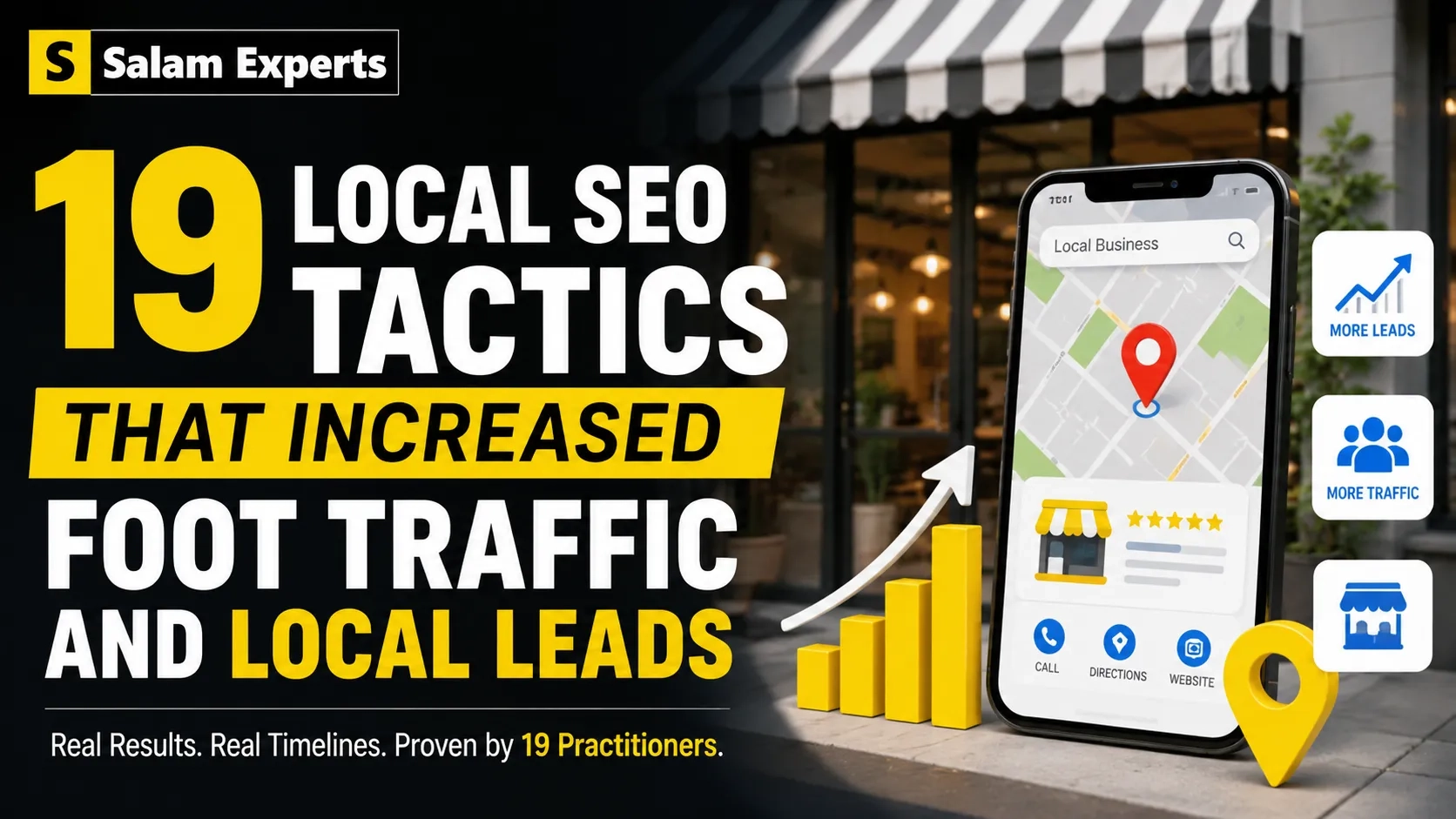
Measured Results and Timelines From Practitioners Who’ve Actually Tested These
Local SEO advice is everywhere. Most of it is recycled, generic, and untethered to results. What’s harder to find is what actually works — the specific tactics practitioners have run with real clients, the timelines they took to pay off, and the measurable lift they produced.
That’s what this article is. We reached out to 19 local SEO practitioners, agency founders, and business owners who run local SEO day-in and day-out, and asked each one a single question: what single tactic moved foot traffic or local leads the most for one of your clients, and how did you measure it?
The answers came back covering everything from Google Business Profile sub-features almost nobody uses, to schema markup deployment, to commissioning a literal mural on the side of a building. Some of these tactics moved the needle in 48 hours. Others took 6 months of compounding consistency. All of them produced numbers worth showing.
Here’s what to expect:
Each contributor names a single tactic, describes how they ran it, shares the measurable result, and the timeline to see that result. No fluff, no generic “optimize your GBP” advice — just specific moves with specific outcomes. Skim the list, find the tactics that fit your business, and pick two or three to test.
At the end, we’ve added a synthesis section called Bilal’s Take — a breakdown of the patterns we noticed across all 19 answers, which tactics produced the fastest results vs. the most durable ones, and which combination we’d run first if we were starting a local SEO push from scratch tomorrow.
- Pair Products Tab with Dedicated URLs
- Guide Testimonials to Include Practice Keywords
- Match Pain Queries to Profile Services
- Mine GSC for the Local Queries You’re Almost Ranking For
- Pursue Micro-Area Cues and Landmarks
- Seed Q&A with City-Specific Detail
- Fix Citations and Create Hyperlocal Sections
- Launch Neighborhood-Specific Pages
- Target High-Intent Comparisons
- Name Areas in Review Responses
- Earn Links from Nearby Authorities
- Niche Down Your Listing Categories
- Answer Urgent Regional Questions Clearly
- Lead Title Tags with Core Terms
- Commission a Community Mural
- Showcase a Standout Local Experience
- Add Fresh Photos Every Week
- Publish Genuine City Guides
- Systematize Ratings and Reply Fast
- Bilal’s Take: What These 19 Tactics Have in Common
- If I Were Starting a Local SEO Push From Scratch Tomorrow
- Need Help Running This for Your Business?
Pair Products Tab with Dedicated URLs
The local SEO tactic that’s moved foot traffic and local leads fastest for me is combining a Google Business Profile “Products” section (properly populated) with dedicated service-area landing pages that match what’s in the Products section one-to-one. Almost nobody uses the GBP Products feature properly, so the bar is on the floor.
Here’s what that looks like in practice. For a retail client in Bristol selling specialist camping equipment, I set up 38 product entries inside GBP itself — not the top-level service categories, but specific products they wanted to rank for (“lightweight 2-person tent”, “merino base layer”, “Alpkit sleeping mat”, and so on). Each GBP product entry linked directly to a product page on the website that carried the same title, a proper description, price, stock indicator, local pickup information, and schema markup (Product + Offer + LocalBusiness).
The trick was making sure the product page mentioned the city name and the shop address three times in natural places (once above the fold, once in the description, once in a “pick up in store” block near the buy button). Not keyword stuffing — just proper local relevance signals.
Measurable results over about four months: the shop’s GBP “product” clicks went from 0 (because they hadn’t been using the feature) to roughly 3,200 a month. Direction requests grew 78%. In-store footfall attributable to Google (tracked via a discount code offered only inside the GBP) produced 142 redemptions in the first eight weeks. Their phone enquiries for specific product availability went from 4 a week to 21 a week.
How long to see it: the Products section itself started driving clicks within 48 hours of being properly populated, because Google surfaces it directly in the local pack card. The footfall lift took closer to 6 weeks because it relied on the compound effect of repeat searches.
The lesson: local SEO isn’t only about the main listing. Every sub-feature of GBP is a ranking and conversion opportunity that most businesses leave empty. The Products tab, the Q&A section, the Updates feature, and the Services list are all underused. Fill them all properly and you’ll outrank competitors who only filled in the basics, without changing anything about your website.

Guide Testimonials to Include Practice Keywords
The single tactic that’s moved the needle more than anything else for our clients is what I call “review stacking with intent keywords” — and it’s shockingly simple once you see it in action.
We work exclusively with law firms, and for most of them, Google Business Profile is where 60-70% of their local leads originate. The problem is that most firms either ignore reviews entirely or just ask clients to “leave us a review.” There’s no strategy behind it.
What we started doing was coaching our clients’ intake teams to send a follow-up message after a successful case resolution with a specific prompt. Instead of “please leave us a review,” we’d guide the client with something like: “Would you mind sharing what type of case we helped you with and what the experience was like?” That subtle nudge gets reviewers to naturally include phrases like “car accident attorney,” “helped me with my divorce,” or “immigration case” — the exact terms people are searching for locally.
Here’s what happened with one family law firm in Phoenix: they had 47 Google reviews when we started, mostly generic five-star ratings with no detail. Over six months, we helped them collect 85 new reviews, and about 70% of them organically mentioned specific practice areas and the city name. Their Google Business Profile went from showing up for 12 local keywords to ranking in the local 3-pack for 34 keywords. Phone calls from their GBP listing increased 140% in that same period.
The timeline was faster than I expected. We saw the first ranking improvements within 8 weeks, and by month four, the phone volume increase was undeniable. By month six, the firm had to hire an additional intake coordinator because they couldn’t keep up.
What made this work wasn’t just the reviews themselves — it was the consistency. Google’s local algorithm rewards businesses that generate a steady stream of fresh, keyword-rich reviews over time. A burst of 20 reviews in one week followed by silence is way less effective than 3-4 detailed reviews per week for six months straight.
The beauty of this tactic is that it costs nothing. No ad spend, no fancy tools. Just a simple process change in how you ask for reviews, and it compounds over time.

Match Pain Queries to Profile Services
One tactic that’s moved the needle is building a “service-area + problem” landing page set, then wiring each page to its own Google Business Profile service and UTM-tagged call tracking number. The pages aren’t generic location pages; they answer one high-intent need (like “emergency hot water repair in Suburb X”) with clear pricing ranges, photos of local jobs, and an embedded map plus driving/parking notes.
I ran this for a suburban trades business (plumber) across 8 nearby suburbs. After publishing 8 pages and adding matching GBP service updates, direction requests in Google Business Profile rose from about 55 a month to about 85 a month (roughly 55%) within 6 weeks, and tracked phone calls from organic/GBP went from about 42 to about 63 a month (around 50%) by week 8. The measurement came from Google Business Profile Insights (calls, direction requests), Google Search Console (queries and page impressions), and CallRail with UTMs to separate GBP clicks from organic search.

Mine GSC for the Local Queries You’re Almost Ranking For
Most local SEO content gets written for keywords pulled from Ahrefs or SEMrush. The bigger opportunity is sitting in Google Search Console — specifically, the queries where you’re ranking positions 8–20 with location modifiers you never deliberately targeted.
For a US auto transport client serving multi-state routes, we exported 90 days of GSC data and filtered for queries containing city or state names. We found 52 location-modified queries — things like “car shipping Dallas to Phoenix,” “auto transport Florida to California,” “vehicle shipping Houston” — where they ranked between position 9 and 19. The client had never built dedicated pages for any of them. Google was already loosely matching them based on city mentions scattered across existing service pages.
We didn’t build new pages. Instead, we identified the existing page Google was ranking for each query, then surgically edited that page: pulled the city or route into the H1 or first 100 words if missing, added a 2-sentence paragraph addressing the specific route or city intent, and updated the meta description to include the location.
Within 8 weeks, 34 of those 52 queries moved into the top 5. Organic clicks from city and route-modified queries grew 76%. Quote requests from outside their primary metro — which had been near zero — hit 22 per month.
The reason this beats writing new location pages is that Google has already told you which pages it considers relevant for which cities. Fighting that signal with new thin location pages is harder than reinforcing the page Google already chose. Most local SEO work creates content from scratch when the keyword research is literally already in your GSC account.
One caveat: this only works once your site has enough impressions to generate signal. Sites under ~1,000 organic impressions per month won’t have enough query data to mine.

Pursue Micro-Area Cues and Landmarks
A high impact tactic was optimizing for micro local intent rather than city level visibility. Most businesses chase broad terms, but stronger results came from creating content around small geographic cues such as nearby roads, landmarks, business districts, and even common route based searches. We aligned those cues with business profile updates, opening hour accuracy, and fresh photos that reflected the local environment people expected to see before visiting.
The effect showed in about two months. Website leads from local queries climbed 35 percent and map driven actions grew 44 percent. That lift came from matching search behaviour to real world movement, which is where local SEO becomes measurable.

Seed Q&A with City-Specific Detail
A tactic that increased local leads faster than anything else we tested is Google Business Profile Q&A seeding. Many companies leave the Q&A section of their GBP empty, which results in Google occasionally drawing in questions posed by random users and responding to them inaccurately or not at all.
What we do instead is proactively populate that section ourselves. We create 8 to 12 questions that reflect what local customers are searching before making a buying decision and answer each of them with answers that naturally contain the name of the service, city and surrounding area. In the case of a plumbing customer in Cincinnati, that would appear as: “Do you provide emergency drain cleaning in Blue Ash?” Then a specific, detailed response about response time, price range and coverage of service area.
This is effective because Google indexes the content of the Q&A section and uses it as supplementary information regarding what the business is and where it is located. The majority of local SEO work is centered on the primary GBP areas such as categories, description and photos. The question and answer section is just lying there untouched, and that’s exactly why it moves faster than fields every competitor already optimized.
In 60 days of seeding the Q&A section in 4 service locations, the same plumbing client experienced a 34 percent growth in direction requests and a 28 percent growth in phone calls directly off their GBP listing, both of which were monitored in Google Business Profile Insights.
Fix Citations and Create Hyperlocal Sections
The tactic that moved the needle fastest for a local client was a systematic citation cleanup paired with a hyperlocal landing page build, and the combination worked better than either would have alone.
The client was a single-location service business that had been operating for 11 years. They had accumulated dozens of directory listings over that time with inconsistent name, address, and phone variations from three different business name changes and two location moves. Google was essentially looking at conflicting signals about who this business was and where it operated.
We audited every citation using Semrush and BrightLocal, corrected the NAP data across 60 plus directories, and simultaneously built out neighborhood-specific landing pages targeting the six zip codes that represented 80% of their customer base. Each page was built around how residents in that area actually searched for the service, not how the business described itself.
Within 45 days of completing the citation cleanup, local pack appearances increased significantly. The landing pages started ranking for zip code specific searches within 60 days. Combined, local leads from organic search increased 52% over the following quarter compared to the same period the prior year.
The lesson was that citation consistency is foundational and most established local businesses are sitting on years of conflicting data that is quietly suppressing their visibility. Cleaning it up before building anything new on top of it made everything else work faster.

Launch Neighborhood-Specific Pages
Service-area landing pages with embedded Google Maps and real customer review snippets for each neighborhood. We used this for a Dubai F&B restaurant group with four locations across JLT, Marina, Business Bay, and Downtown.
Before we started, their website had one “Locations” page with an address list. Walk-in traffic was decent at the flagship but the three satellite locations were underperforming by about 40% against projections.
What we built: Four dedicated pages, one per neighborhood. Each page had: the full menu localized with neighborhood-specific promotions, embedded Google Maps with the pin on that exact outlet, five real reviews scraped from that specific Google Business Profile (with permission), photos taken in that specific dining room, and a block explaining parking, nearest metro, and landmarks.
Each page targeted the “restaurant [cuisine] [neighborhood]” query. We added LocalBusiness schema with the correct coordinates, opening hours, and accepts reservations flag for each outlet.
Measured results after 120 days: Organic traffic to the four neighborhood pages combined 4,100 visits/month (from roughly zero at launch). Phone calls tracked via dynamic number insertion: 312/month across all four outlets. Reservations via the online form attributed to these pages: 147/month. Walk-in traffic at the three weaker outlets: up roughly 28% year over year per the client’s POS data.
Two things that made it actually work: Real photos, not stock. We sent a photographer to each outlet. Menu photos from the actual chefs. This matters because Google Maps users cross-reference the website photos with the restaurant photos, and mismatches hurt trust. The first month we saw nothing. Local SEO results take 60 to 90 days. Most clients quit before the compound effect kicks in. Hold the line.

Target High-Intent Comparisons
A tactic that produced meaningful local lead growth was optimizing for high intent comparison searches tied to the local area. Instead of chasing broad city keywords, content was built around decision stage queries that included location terms, trust signals, and practical next step information. Supporting schema, unique local imagery, and tighter title tags helped those pages stand out in search without sounding over optimized or repetitive.
We measured progress through local organic conversions, click to call actions, and assisted lead value in analytics. In roughly three months, click to call actions grew 29 percent, local organic leads increased 21 percent, and average engagement on those localized pages improved enough to show stronger buyer readiness.

Name Areas in Review Responses
The local SEO tactic that pays out the longest is the simplest one nobody commits to: every review response names the neighborhood the job happened in.
Most owners reply to 5-star reviews with a generic “Thanks!” and move on. That response is public text Google indexes on the Google Business Profile. Six months of responses that say “Thanks for having us out to your place in Broad Ripple last Tuesday to clear the kitchen line” and the profile starts ranking for “[service] near Broad Ripple” without any ad spend.
A plumbing company I work with in Indianapolis set a house rule: every review response names one neighborhood and one specific fix. Two lines, thirty seconds. The owner did it from her phone at the end of each day.
What we measured: Calls from GBP up about 30% over four months, concentrated in the neighborhoods she’d named in responses. Map-pack appearances for neighborhood-specific queries (“plumber broad ripple,” “garbage disposal meridian-kessler”) went from zero to ranking in the top three. Time-to-first-measurable-lift was about six weeks. The early signal was GBP impressions climbing faster than website traffic, which is the tell that local ranking (not Google search generally) is moving.
The reason it works has nothing to do with SEO cleverness. Review responses are the only part of the profile the owner updates regularly with fresh, specific, location-bound language. Google treats that as recency plus proximity. Most competitors never touch the response field, so the bar is low.
Caveat: the one thing that kills the effect is AI-generated generic responses. Copy-paste “Thank you for the kind words” does nothing. The neighborhood has to be real and the fix has to be specific.

Earn Links from Nearby Authorities
The tactic most local businesses ignore completely: getting backlinks from other local websites. Not directories. Not generic citation sites. Actual local sources — the regional newspaper, the local business association, the municipality’s supplier page, the area chamber of commerce, other businesses in the same city that complement yours without competing.
I worked with a local service business that had decent on-page SEO but was stuck on page two for their core keywords. Their Google Business Profile was optimised, they had consistent NAP data across directories, but nothing was moving.
What changed things was a deliberate push to get mentions and links from locally rooted sources. We identified which local organisations, media outlets, and complementary businesses had websites with real traffic and relevance to the area. Then we went after those placements systematically — some through outreach, some through sponsorships, some just by showing up and being part of the local business ecosystem.
Within about three months, local pack visibility improved noticeably. Within five, they were picking up calls from people who found them through search and specifically mentioned they’d seen the business mentioned somewhere local.
The thing about local SEO is that Google is trying to figure out whether you’re genuinely embedded in a community or just optimised to look like you are. A backlink from a national DR70 site does almost nothing for that signal. A backlink from the local trade association or a write-up in the regional business press tells Google something that metadata never can. Local authority is built locally. Obvious in hindsight, chronically underused in practice.

Niche Down Your Listing Categories
Running a dental practice in Bradenton, FL taught me fast that showing up on Google Maps for “dentist near me” meant nothing if your listing didn’t match exactly where and who you are. The single tactic that moved the needle for us was obsessively optimizing our Google Business Profile categories and services to mirror our actual specialties — specifically listing “dental implants,” “Invisalign,” and “teeth whitening” as distinct services, not just burying them in a general description.
Before that, we were getting foot traffic from people looking for pediatric care we don’t even offer. Tightening our GBP to clearly signal adult and senior restorative dentistry filtered out mismatched traffic and pulled in patients who were actually ready to book implant consultations or snap-on denture evaluations.
The results weren’t overnight — it took roughly a few months before we noticed the quality of inbound calls shift noticeably. But the appointments that did come in were far better matched to our actual services, which meant less time spent on consultations that went nowhere.
If you’re a specialist of any kind, stop trying to appeal to everyone on your local listing. Niche down your GBP categories hard, keep your service list updated, and make sure your address, hours, and phone are identical everywhere online — even one mismatch can quietly tank your local ranking.

Answer Urgent Regional Questions Clearly
For DFW RV Rentals, our most impactful local SEO tactic was developing highly specific, problem-solving content on our website and blog, directly addressing urgent local needs. Instead of generic RV tips, we focused on scenarios unique to those displaced in the Dallas-Fort Worth area.
We created articles that answered critical questions for families impacted by home damage, such as “Can I live in an RV on my property?” or “Does insurance cover RV rentals?” We also provided DFW-area planning tips, like knowing 30-amp vs. 50-amp needs for our hot summers, and highlighted our service for delivery and setup at the point of need.
This strategy brought in incredibly high-intent local leads, often from individuals or relocation teams searching for specific disaster recovery solutions. We saw a steady increase in direct inquiries from insurance adjusters and families needing immediate temporary housing, with noticeable results appearing within about three to six months after consistently publishing this targeted content.

Lead Title Tags with Core Terms
One local SEO tactic that consistently moves the needle is placing the target keyword as far left as possible in the title tag for a page.
This matters because the title tag is one of the strongest signals Google uses to understand what a page is about. When the main keyword is placed at the beginning, it makes the page immediately clear and relevant for that search. Instead of burying the keyword or trying to get too creative with the wording, keeping it simple and direct tends to line up better with how people actually search.
For example, if the goal is to rank for “New Orleans HVAC Company,” starting the title with that exact phrase helps clearly signal to Google that the page matches that search.
In terms of results, this is pretty easy to measure just by looking at your target keyword’s rankings. After updating title tags across key service pages, it’s common to see movement in rankings, as well as more organic clicks and inbound leads from those pages.
Timing really depends on how competitive the keyword is. Sometimes you’ll see rankings start to change in as little as a day after updating a title tag. Other times, it can take a few weeks to see more noticeable results. Either way, it’s one of the easiest changes you can make that can still have a real impact, without needing to redo the entire page.

Commission a Community Mural
One local SEO tactic that unexpectedly drove more local attention for our business was commissioning a mural on the side of our building. The original goal was simple: make the space look better and create something memorable. What happened next was far more valuable. The mural became a neighborhood photo spot. People started stopping by to take pictures, post selfies on social media, and tag the business, which created a steady stream of local visibility without spending anything on ads.
We did not run a formal foot traffic study, so I would not pretend we tracked an exact percentage increase. But we saw a noticeable lift in local awareness, more walk-in attention, more social tags, and more word-of-mouth from people in the area within the first few weeks after it went up.
What made it especially effective against bigger competitors was that it felt local and authentic. A chain can spend more on ads, but it cannot easily create something that feels tied to a specific neighborhood. The mural did not come across like a marketing campaign. It felt like a community moment, and that made people want to interact with it and share it.

Showcase a Standout Local Experience
I’m the Creative Director behind Flambe Karma, so I’m very involved in how our restaurant is presented online and how that matches the in-person experience in Buffalo Grove and Glen Ellyn. The local SEO tactic that helped most was aligning our local content around experience-driven intent, not just “Indian restaurant near me.”
We leaned into what actually makes us different locally: Indian-French fusion, flambe presentation, date-night/family-night ambiance, and signature dishes like Flambe Scallops and Mango Habanero Flambe Paneer. That gave people a clearer reason to choose us before they ever walked in, especially when they were searching for something memorable rather than just convenient.
The main results we measured were better local lead quality: more people arriving already familiar with the atmosphere, asking about specialty flambe dishes, and mentioning things they had seen in our story, menu, or events content. In restaurants, that matters because discovery traffic is nice, but intent-rich traffic is what turns into reservations, walk-ins, and catering inquiries.
Timing-wise, this was not instant. We saw the earliest signals once our story, blog, menu, and events pages were all reinforcing the same local identity, and over time it helped create stronger local recall. My advice is to optimize around the experience people are actually hoping to find in your area, not just your category.

Add Fresh Photos Every Week
Posting photos weekly on my Google business profile has significantly increased the number of leads generated from local searches. By adding new photos that showcase current listings as well as easily identifiable local landmarks, I was able to create instant credibility for those searching. The monthly volume of calls into my office is up 37% compared to the same time last year. With each week’s posts, I am demonstrating my continued commitment to the local community through these visual representations.

Publish Genuine City Guides
Running 15 furnished rental units across Detroit and Chicago, I’ve had to get scrappy about local SEO — and the single tactic that moved the needle most was building out a genuinely useful area guide directly on our website.
Instead of just listing properties, we created dedicated pages for Detroit restaurants, museums, nightlife, transportation, sports arenas, hospitals, and even biking and running paths. These aren’t thin pages — they reflect real local knowledge from people who actually live and breathe these cities.
The result was that guests started finding us through searches that had nothing to do with “furnished rentals.” Someone searching for things to do near the Detroit Riverwalk or hospitals in Detroit would land on our site, then naturally discover our properties. That kind of warm, intent-driven traffic converts differently than cold ad traffic.
We also added walkthrough videos to each property page after guests specifically mentioned in reviews that they wanted a clearer picture before booking. That one change, driven entirely by real guest feedback, produced a 15% increase in booking conversions. The lesson: your guests are literally telling you what will rank and convert — you just have to listen.

Systematize Ratings and Reply Fast
The tactic that delivers the most consistent results for local businesses we work with is a structured review generation process combined with fast, responsive review replies.
Most businesses ask for reviews occasionally and informally. What actually moves the needle is building the ask into every transaction: a follow-up text 24 hours after service, a direct link to the GBP review page, and a short personal note from the service provider. When you pair that with responding to every review within 24 hours, Google sees your profile as active and trustworthy.
One local home services client went from 18 reviews and a 3.8-star average to over 140 reviews and a 4.7-star rating in about four months. Their map pack visibility increased substantially, and inbound calls from local search grew roughly 60% during that period.

Bilal’s Take: What These 19 Tactics Have in Common
After reading through every answer, three patterns jumped out that the individual contributions don’t make obvious on their own.
Pattern 1: The fastest results came from filling empty fields, not building new content
Look at how many of these tactics start the same way: “most businesses leave this section empty.” The GBP Products tab. The Q&A section. Service-specific GBP categories. Review responses with neighborhood names. Title tag positioning. None of these required new pages, new ad spend, or new content production. They required filling in things competitors had ignored. The pattern is clear — in local SEO, the highest-ROI work is usually the work nobody bothered to finish.
Pattern 2: Specific beats generic, every single time
The contributors who reported the biggest lifts — 78% in direction requests, 140% in phone calls, 84% in clicks — all share one trait: they got more specific than their competitors. Not “dentist near me” but “senior restorative dentistry in Bradenton.” Not “RV rentals” but “RV rentals for families displaced by home damage in DFW.” Not “great plumber” but “unclogged the kitchen line in Broad Ripple last Tuesday.” Google’s local ranking system rewards specificity because specificity is what users actually search for at the moment they’re ready to buy.
Pattern 3: Most tactics take 6–12 weeks. The ones that don’t are usually data-driven
Almost every contributor mentioned a timeline of 6 weeks to 4 months before results showed. The exceptions — things that moved within days or even hours — were the data-driven optimizations: title tag changes, GSC-driven page edits, fixing technical issues. If you need fast results, start there. If you can wait, the compounding tactics (reviews, neighborhood landing pages, citations, local backlinks) produce more durable lifts that don’t reverse when you stop.
If I Were Starting a Local SEO Push From Scratch Tomorrow
Here’s the order I’d run these tactics in, based on speed of impact and dependency on other work:
| # | Tactic | Timeline | Why First |
|---|---|---|---|
| 1 | Audit GSC for almost-ranking local queries | 2–8 weeks | Reveals where Google already sees you |
| 2 | Fix title tags and GBP categories | 1–3 weeks | Quickest possible wins, zero risk |
| 3 | Clean up NAP citations sitewide | 4–6 weeks | Removes conflicting signals |
| 4 | Fill empty GBP sections (Products, Q&A, Services) | 48 hours–6 weeks | Competitors leave these blank |
| 5 | Systematize review collection with intent prompts | 8–16 weeks | Compounds for years once running |
| 6 | Build neighborhood/route landing pages | 8–12 weeks | Now you have ranking data to inform structure |
| 7 | Pursue local backlinks from real local sources | 12–20 weeks | Slowest but most durable lift |
The most common mistake I see businesses make is starting at step 6 or 7 — building content and chasing backlinks — before they’ve done steps 1 through 5. You can do it that way, but the content ranks slower because Google doesn’t yet trust the local signals on your site, and the backlinks pass less authority because the page they’re pointing to isn’t reinforced by the rest of your site’s local data.
Need Help Running This for Your Business?
At Salam Experts, we run this exact playbook for service businesses, e-commerce stores, and US auto transport companies that want to grow local visibility without throwing money at ads.
If you want to see how we’d apply these tactics to your business specifically, our Local SEO Services page breaks down our process, or you can review our case studies to see results from clients in similar industries.
For auto transport and car shipping companies specifically, we have a dedicated service page covering SEO and digital marketing for car shipping companies — because route-based local SEO works differently than location-based local SEO, and we’ve documented the difference.