“Should I target multiple keywords on one page?”
It’s the most common keyword strategy question I get, and the honest answer is the one nobody wants to hear: it depends.
Sometimes targeting 5 keywords with one page is exactly right and saves you from creating thin, redundant content. Sometimes targeting just 2 keywords with one page is wrong and the page never ranks for either of them. The difference comes down to one factor — and it’s not what most SEO guides say it is.
This article walks through when multi-keyword targeting works, when it backfires, and gives you a framework to decide for any keyword group on your site.
What You’ll Learn
- The single test that determines whether two keywords belong on the same page
- Three real-world scenarios with examples and SERP analysis
- How keyword cannibalization actually happens (and how to spot it)
- The 5-minute SERP overlap check before you commit to a strategy
- When to consolidate pages and when to split them
The Only Test That Matters: Search Intent
Two keywords belong on the same page if — and only if — the same content satisfies what users searching for both terms are looking for.
That’s it. That’s the whole rule. Search volume doesn’t matter. Keyword similarity doesn’t matter. What matters is whether one piece of content can fully serve both queries.
How Google sees it: Google’s job is to return the best result for a query. If two queries genuinely want the same answer, Google ranks the same pages for both. If two queries want different answers, Google ranks different pages — and trying to force one page to rank for both will hurt you in both.
Three Scenarios — And What to Do With Each
Scenario 1: Same Intent, Different Phrasing → ONE PAGE
These are the easiest cases. Same query, different words.
Example keyword group:
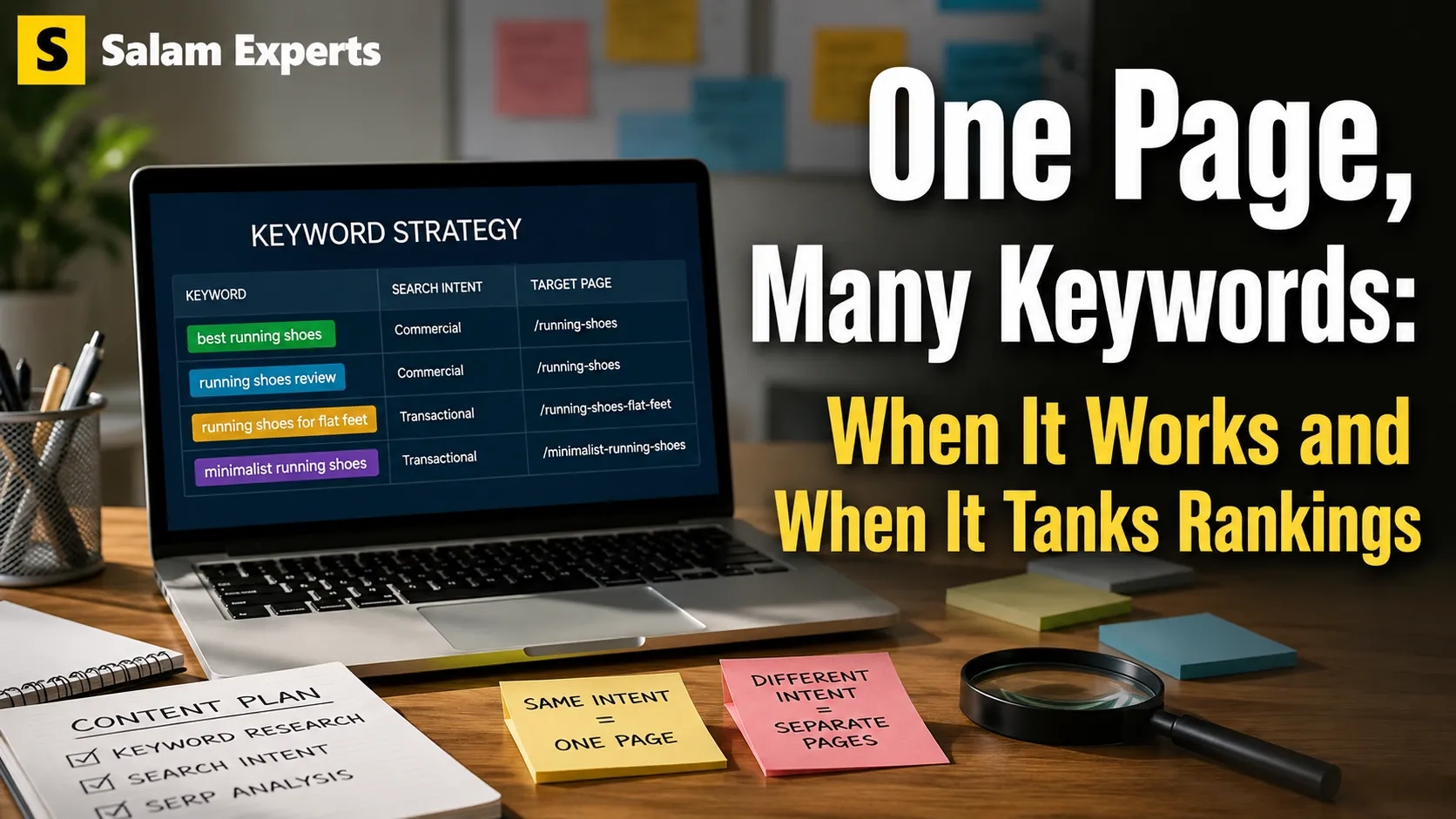
- “best running shoes”
- “top running shoes”
- “running shoes review”
- “running shoes recommendations”
All four queries want the same thing: a curated list comparing running shoes. The user searching ‘best running shoes’ is satisfied by the same content as the user searching ‘top running shoes.’ One well-written list page should target all four.
How to verify: Search each keyword on Google. If the top 5–10 results are mostly the same URLs, the queries share intent. Same SERP = same intent = one page.
Scenario 2: Related But Distinct Intent → SEPARATE PAGES
These are the cases where smart-sounding consolidation tanks rankings.
Example keyword group:
- “running shoes for flat feet” → user wants stability/motion-control shoes
- “running shoes for marathon” → user wants long-distance cushioning
- “running shoes for beginners” → user wants entry-level recommendations
- “minimalist running shoes” → user wants barefoot-style shoes
All four are about running shoes. None of them want the same content. A user searching ‘running shoes for flat feet’ doesn’t want a generic ‘best running shoes’ list — they want shoes that specifically address overpronation. Trying to cover all four on one page produces something that satisfies none of them.
Each gets its own page. The pages can interlink, but they should not compete.
Scenario 3: Different Topics Entirely → DEFINITELY SEPARATE
This is the mistake I see most often on service business websites — and it’s the example Aaron Traub flagged in our expert roundup on overlooked technical SEO issues.
Real audit example: A home organizing company had one page trying to rank for ‘home organizing,’ ‘decluttering services,’ ‘packing services,’ and ‘unpacking services.’ The page got impressions for all four keywords but never ranked well for any. Competitors had separate pages for each service, and they ranked.
Source: 20 overlooked technical SEO issues that significantly impact rankings.
When the keywords represent different services or different products, separate pages aren’t just better — they’re necessary. Each service deserves its own optimized page that focuses entirely on the user searching for that specific service.
The 5-Minute SERP Overlap Check
Before deciding to target multiple keywords on one page, run this check. It takes 5 minutes and saves you from making the wrong call.
- Search each keyword on Google in an incognito window. Record the top 10 results for each.
- Compare the URLs across SERPs. Count how many results appear for both keywords.
- Look at the SERP features. Same featured snippets? Same People Also Ask boxes? Same related searches?
- Click through to top 3 results for each query. Read what they’re actually about.
- Make the call: 5+ overlapping URLs and similar content style = same page. Less than 3 overlapping = separate pages. 3-5 = judgment call, lean toward separate.
What Happens When You Get It Wrong: Keyword Cannibalization
Keyword cannibalization is when two or more pages on your site target the same keyword and end up competing against each other in search results. Instead of one strong page ranking on page 1, you get two weak pages bouncing between positions 8 and 15.
Why it hurts you
- Authority gets split — backlinks that should reinforce one page get distributed across two
- Click-through rates drop — Google rotates which page ranks, confusing your performance data
- Internal linking gets confused — your own internal links don’t know which page to favor
- Conversions suffer — users land on the page Google decided to rank, which may not be your conversion-optimized version
How to spot it
Open Google Search Console. Go to Performance → Pages. Filter by your target keyword as the query. If 2 or more pages show impressions or clicks for the same keyword, you might have cannibalization.
Then check: are both pages genuinely targeting that keyword? Or is one of them ranking accidentally because it mentions the term in passing? The fix differs based on the answer.
When to Consolidate Pages
If you’ve already created multiple pages targeting overlapping intent and they’re cannibalizing each other, you have three options:
Option 1: Merge the content
Combine the strongest elements of both pages into one comprehensive page. Redirect the weaker URL to the stronger one with a 301. The merged page benefits from consolidated authority, links, and topical depth.
This is the most common fix. See our guide on 301 redirects for implementation.
Option 2: Differentiate the intent
If on closer inspection the pages do serve different intents, rewrite each to make the difference explicit. Adjust title tags, H1s, and content focus so each page clearly signals its specific intent.
Option 3: De-optimize the weaker page
Sometimes one page is genuinely your priority and the other is incidentally ranking. In that case, remove the target keyword from the weaker page’s title, H1, and meta description. Don’t delete the page — just stop sending it ranking signals for that keyword.
What to Care About — And What Not To
Care about:
- Search intent overlap — does the same content satisfy both queries?
- SERP overlap — are Google’s top results for both keywords mostly the same URLs?
- User journey — would a user searching keyword A be satisfied with what users searching keyword B want?
- Conversion paths — are both keywords at the same buying-intent stage?
Don’t care about (these don’t determine the decision):
- Keyword volume difference — high-volume and low-volume keywords with the same intent still belong on one page
- Word similarity — ‘cheap shoes’ and ‘affordable shoes’ are nearly identical text but might have different SERPs based on user intent
- Keyword difficulty — difficulty doesn’t change whether intent overlaps
- Total keyword count — there’s no magic number. One page might rightfully target 50 long-tail variations of the same intent
Quick Decision Framework
Same intent, different phrasing (synonyms, question variants) → ONE page targeting all variations
Same broad topic but distinct sub-intents (different audiences, different needs) → SEPARATE pages, interlinked
Different services or different products → DEFINITELY separate pages
Top SERPs share 5+ URLs across both keywords → ONE page (intent overlaps)
Top SERPs share fewer than 3 URLs across both keywords → SEPARATE pages (intent differs)
Already cannibalizing — multiple pages competing for same query → Consolidate, redirect, or de-optimize the weaker page
Two More Real Examples to Make This Concrete
Example A: SaaS company landing pages
A SaaS company has these keyword targets:
- “project management software”
- “task management software”
- “team collaboration software”
Tempting to use one page for all three. SERP check shows: top 10 results overlap by ~6 URLs across the three queries. Most ranking pages frame themselves as ‘all-in-one work management platforms.’ Same intent, different phrasing.
Verdict: ONE page, with title tag and content using all three terms naturally.
Example B: Auto transport service
A car shipping company has these keyword targets:
- “car shipping services”
- “motorcycle shipping services”
- “boat transport services”
Same broader category (vehicle transport) but the user searching for motorcycle shipping has different concerns than the user searching for car shipping (loading methods, regulations, pricing models). SERP check confirms: minimal URL overlap.
Verdict: SEPARATE pages, each optimized for its specific service. See our auto transport SEO guide for industry-specific patterns.
The Bottom Line
Multi-keyword targeting is neither good nor bad. It’s a tool that fits some situations and breaks in others. The decision rule is simple: same intent → same page; different intent → different pages.
If you’re unsure, run the SERP overlap check. If you’ve made the wrong call already, the fix is mechanical — consolidate, redirect, or differentiate. None of these problems are unfixable.
What is hard to fix is the months of wasted ranking effort that happens when you don’t audit for these mistakes in the first place.
Want Us to Audit Your Keyword Strategy?
Keyword cannibalization, intent mismatches, and on-page targeting issues are all part of our $500 SEO audit — along with technical, backlink, and competitor analysis. We’ll tell you exactly which pages are competing against each other and what to do about it.
→ Book your SEO audit or Read about our on-page SEO services
Related Reading
- Mastering keyword research — building the keyword list before you decide on grouping
- All types of keywords in SEO — informational, navigational, transactional and how each affects targeting
- What are SERP types — reading SERPs to understand intent
- E-commerce keyword research — product vs category page targeting decisions
- 20 overlooked technical SEO issues — includes the multi-keyword targeting case from our expert roundup
- Heading tags SEO best practices — how H1/H2 structure reinforces single-keyword focus