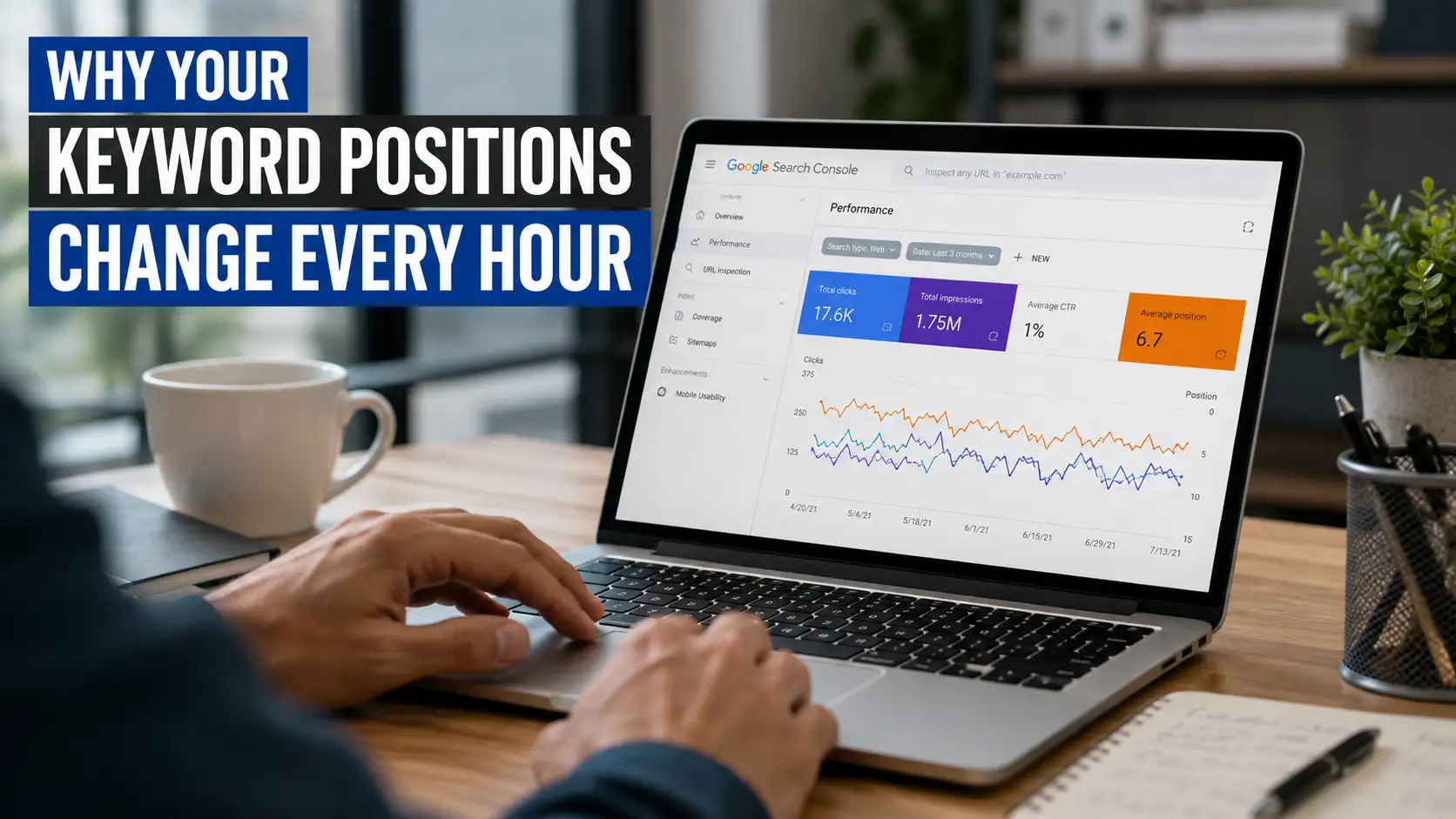
I was tracking the same keyword across multiple client sites in Google Search Console. Position 4 at 9 AM. Position 8 by noon. Back to position 3 by evening. Same keyword. Same page. Same day.
This was not a one-off glitch. It happened consistently — sometimes shifting every few hours across different clients, different niches, different countries.
If you have ever filtered a keyword in GSC, checked its position, come back a few hours later, and seen a completely different number — this is what is actually happening behind the scenes.
Google Is No Longer Waiting for Named Updates to Re-Rank You
For years, the SEO industry operated on a predictable rhythm. Google would announce a core update, rankings would shuffle for a couple of weeks, things would settle, and you would have months of relative stability before the next one.
That model is dead.
Google updated its core updates documentation to include this language: “We’re continually making updates to our search algorithms, including smaller core updates. These updates are not announced because they aren’t widely noticeable.”
On July 9, 2026, Google reinforced this by confirming that smaller core updates now roll continuously without public announcements. No status dashboard entry. No blog post. No warning.
Third-party volatility trackers from Semrush and Sistrix recorded elevated ranking movement throughout June and July 2026 outside any announced update window — which is exactly what continuous unannounced updates would produce.
This means your keyword positions are being recalculated constantly. Not daily. Not weekly. Continuously.
The Data Center Factor
Google operates approximately 130 data center campuses globally, spread across 43 cloud regions and 130 zones, serving over 200 countries and territories.
Here is the part most people miss: these data centers do not sync instantly.
When a user in London searches a query, they might hit a different data center than a user in Birmingham searching the exact same query at the exact same time. Each data center can return slightly different rankings depending on when it last synchronized its index.
This is not a bug. This is how distributed infrastructure works at scale. It has been this way since Google’s early days — the original “Google Dance” from 2000 to 2003 happened precisely because data centers received algorithm updates at different times. The difference now is that instead of monthly syncs, Google runs continuous incremental updates (what they call “everflux”), which means these micro-discrepancies happen all day, every day.
When you check your keyword position in GSC at 9 AM and see position 4, then check at noon and see position 8, you may be seeing the aggregated result of searches hitting different data center configurations throughout those hours.
Google A/B Tests Your Rankings in Real Time
Google does not just calculate rankings and serve them. It actively experiments with different ranking configurations to measure which one produces better user satisfaction.
Your page might sit at position 3 for one test group of searchers and position 7 for another — simultaneously. Google measures click-through rates, dwell time, pogo-sticking, and other engagement signals across both groups, then settles on whichever configuration performed better.
Until the next experiment starts.
This is documented behavior. Google has acknowledged running thousands of search experiments per year. These live A/B tests mean that at any given moment, your “real” position for a keyword is not a single number — it is a range across different experimental groups and data center configurations.
2026 Has Been the Most Volatile Year on Record
The data backs this up:
- The March 2026 core update (March 27 to April 8) was the most volatile core update ever recorded. Nearly 80% of top-3 positions shifted during that 12-day window.
- The Semrush Sensor reached 9.5 out of 10 during late February and early March 2026.
- The volatility did not stop when the March update “completed.” Elevated movement continued through April, May, June, and July — driven by the continuous unannounced updates Google confirmed.
- The May 2026 core update followed closely, completing in just 12 days — the fastest rollout in years.
- Google released a Discover-only update in February 2026 and a spam update in March 2026 — three official updates in five weeks.
The update frequency itself has fundamentally changed. Google is no longer operating on a quarterly cadence. Multiple systems are shifting simultaneously, which is why SERPs feel chaotic even on days with no announced update.
What This Means for How You Track and Report Rankings
If you are still checking a keyword position once a day and treating that number as ground truth, you are working with incomplete data. Here is how to adjust:
Use GSC’s average position, not spot-checks. GSC already calculates average position across all impressions for a given query over a date range. This smooths out the hourly noise. That averaged number is more representative than any single point-in-time check.
Track 7 to 14 day trends, not daily snapshots. A keyword dropping from position 4 to position 8 on a single day is noise. A keyword declining from an average of position 4 to an average of position 8 over two weeks is a signal worth investigating.
Pair position data with impressions and clicks. Position alone tells an incomplete story. A page sitting at average position 6 with consistent impressions and steady clicks is performing. A page flickering between position 2 and position 12 with erratic clicks has a stability problem that needs diagnosis.
Stop blaming site changes for single-day ranking drops. Before assuming your latest content update or technical change caused a ranking shift, check whether the movement correlates with broader market volatility. The Semrush Sensor and Sistrix volatility index are free tools that show whether the entire SERP is churning — not just your site.
Report to clients in ranges, not absolutes. Instead of telling a client “you rank position 5 for this keyword,” consider framing it as “your average position for this keyword over the past 14 days is between 4 and 7, with a stable trend.” This is more honest and sets better expectations.
The Bigger Picture
Google’s own documentation now states plainly: “positions in Google Search results aren’t static or fixed in place.”
That single sentence should change how every SEO practitioner thinks about ranking reports. Your rankings were never as stable as you thought they were. Google Search Console was always smoothing out constant movement underneath, presenting you with an averaged number that made the SERP look more static than it actually is.
The hourly position changes I observed across client sites are not anomalies. They are the system working as designed — a continuous recalculation engine running 24/7 across 130+ data centers, processing unannounced algorithm updates, running live experiments, and re-evaluating every page against every competitor in near real-time.
Understanding this does not mean you should stop tracking rankings. It means you should stop treating any single ranking check as a reliable snapshot of reality.
Track trends. Watch the averages. And focus your energy on the metrics that do not fluctuate with Google’s infrastructure — clicks, conversions, and revenue.